Showing posts with label james m cain. Show all posts

Monday, January 7, 2013

A Not So Cosy Mystery: A Brief Overview of Hard-Boiled and Noir Fiction Part One

The articles in this series were originally written for and posted at Literary Exploration.

There are literally dozens of great authors and great novels that could have been suggested as essential reading for this guide. The writer of the article went through agonising decisions over who to leave out and is more than aware that your favourite author probably hasn’t been mentioned but feel free to start a discussion in the comments. 

A (not-so) Brief Overview of Hard-boiled and Noir Fiction

Part One - A Not So Cosy Mystery (1930s and 1940s)

In 1887 Arthur Conan Doyle created Sherlock Holmes and the success of his great detective spawned an entire genre of detective fiction that imitates to some degree or another to this date. The light-hearted and relatively straightforward approach towards solving crime reached its pinnacle in what has become known as The Golden Age of crime fiction, the 1920s and 1930s. The large majority of the authors writing in this popular style of fiction were British and this was reflected in the settings and general sense of manners contained within.

The inter-war years were a difficult time both socially and politically and this change in society saw crime fiction edge towards what was a more realistic, and more depressing tone with content that would almost certainly shock the characters found within an Agatha Christie novel. The pioneers for this movement towards realism were, perhaps unsurprisingly, Americans and this style became known as hard-boiled.

Taking its name from the style of preparing eggs that leaves the hard shell intact and the yolk fully solidified, the protagonists of hard-boiled fiction are tough skinned, street wise, sharp tongued and ready to solve a mystery with violence if necessary (and it almost always is.)

These are cops, private detectives, ordinary citizens coming up against prohibition gangsters, organised crime, crooked cops, and looking to stand up for what is morally correct. One lone man against an entire system; grown cynical and expecting the worst of people but hoping for the best, he’s the kind of guy who’s seen every horror and will surely see worse before he solves this case.
Hard-boiled is a naturalistic style of writing combined with a cynical, world-weary attitude. This evolved in to Noir fiction, a genre that is if anything even darker; it’s protagonists are usually morally suspect at best and at worst are degenerates, psychopaths and cold blooded murderers.

The most succinct and accurate definition of the difference between the two styles is this:
Noir is the world. Hard-boiled is the character. You can have Noir without the Hard-boiled, but not the other way around.
Carroll John Daly is credited with creating the first hard-boiled story for Black Mask magazine in the 1920s and his first hard-boiled novel Snarl of the Beast (1927) marks the first of, what I shall deem, the essentials of the genre. At the time Daly was the most popular author of the genre he essentially started but he has since been unfairly labelled a hack (the writers opinion only) for simply not being of the same quality as the famous authors he inspired.

Hot on the heels of Daly was Dashiell Hammett, the former Pinkerton operative turned author, who between 1929 and 1934 published the only novels he ever wrote. At least two of which are widely considered masterpieces of the genre. Red Harvest (1929) featuring the unnamed detective known as The Continental Op and perhaps his most famous work The Maltese Falcon (1930); it’s PI Sam Spade is credited as being the archetype that all other hard-boiled detectives are based on, with his personal detachment from the case and unflinching devotion to ensuring justice his strongest characteristics.

The man who would follow in his footsteps, Raymond Chandler, said of him:
“Hammett gave murder back to the kind of people that commit it for reasons, not just to provide a corpse...He put these people down on paper as they are, and he made them talk and think in the language they customarily used for these purposes.”

A more obscure name with an essential of the genre crops up next, Raoul Whitfield; his debut novel Green Ice (1930) was described by Dashiell Hammett as “280 pages of naked action pounded into tough compactness by staccato, hammerlike writing” but he never seemed to live up to his early success and retired from writing fiction only a few years later.

There are three names that everybody mentions when discussing this period of early hard-boiled American fiction. Hammett is the first, his Maltese Falcon regularly winning polls for best hard-boiled novel also, but to his name you will also find added the words Chandler and Cain.

Raymond Chandler decided to try his hand at writing after losing his job during the Depression and in the process seemed to capture America the way that America wants to be remembered. His hero is Philip Marlowe, his beat is L.A., a brave warrior in the Sam Spade mould but with a softer underbelly. In his classic debut The Big Sleep (1939) we find a PI who likes to drink, is handy in a fight and cynically wisecracks his way through most situations but this is also a man who plays chess, reads poetry and has philosophical questions playing on his mind. The generally acknowledge highpoint in Chandler’s (and Marlowe’s) career would come later with The Long Goodbye (1953) and demonstrates the literary nature of the genre, author and character.

James M. Cain on the other hand was largely active in the noir category; in his major works his characters were not detectives but men corrupted by sex and money. Double Indemnity (1943) is the story of an insurance agent who plots against his employers to get a woman and some money. The Postman Always Rings Twice (1934) features a mixture of sexuality and violence in a love triangle situation.

With the big names out of the way I will share two more important figures in the formative years of this genre that are a lot harder to find and therefore more obscure.

Cornell Woolrich, who also wrote with some success under the pseudonym William Irish, is virtually out of print today but his importance on the development of the genre remains. His work more often that not evoked despair and cynicism in the everyday life scenarios and as was the case with the bleaker examples of the genre was more popular in France than America. If you can find them, I recommend The Bride Wore Black (1940) and The Black Angel (1943) as good starting points.

Dorothy B. Hughes is another essential early noir author that few people have heard of. Her In A Lonely Place (1947) has recently been republished as a Penguin Modern Classic and quite rightly so, is a fine example of her tightly plotted and tense approach towards noir and features a truly heinous protagonist in Dix Steele. Amongst her other work The Blackbirder (1943) is a story of fear, paranoia and dread.

In Part Two I’ll be taking a look at the second generation of authors who worked during the boom in paperback fiction of the 1950s.

You can find me discussing books on Goodreads, discussing movies on Letterboxd, tweeting nonsense as blahblahblahtoby  feel free to say hi.

Wednesday, September 21, 2011

Noir-a-Thon Double Feature Part 2: Double Indemnity (1944)

Sadly the DVD of Alfred Hitchcock's Shadow of a Doubt we bought from eBay would not play so we had to scratch it off of the list, this means we jump straight through to 1944 and Billy Wilders classic, Double Indemnity. If you missed the first part of this weeks double feature you'll find it here and all the Noir-a-thon reviews here.


Director: Billy Wilder
Starring: Fred MacMurray, Barbara Stanwyck, Edward G. Robinson
Year: 1944
Country of origin: USA
Language: English

Synopsis: Star insurance salesman Walter Neff (Fred MacMurray) narrates his fall from grace as he encounters a dame he can't resist (Barbara Stanwyck) with an offer he can't refuse.


What Indie Nights? review

Greetings once more, BBBG readers, long time no see.
Following on from yesterday's This Gun For Hire post we're bowing at the pedestal of the noir classic Double Indemnity.


As a total film neophyte before I met Toby, I had to admit that I had never heard of the film, or of Billy Wilder (Sacrilege! Disgust! Fainting and general astonishment ensue!), but in much the same way that one watches Casablanca or Gone With The Wind for the first time having had them built up within popular culture all one's life, the inevitable starting point will be 'It can't be as good as all that - it's so old!'. The amount of sour grapes I've had to eat with that sentiment in mind, faithful readers, I don't even want to talk about...

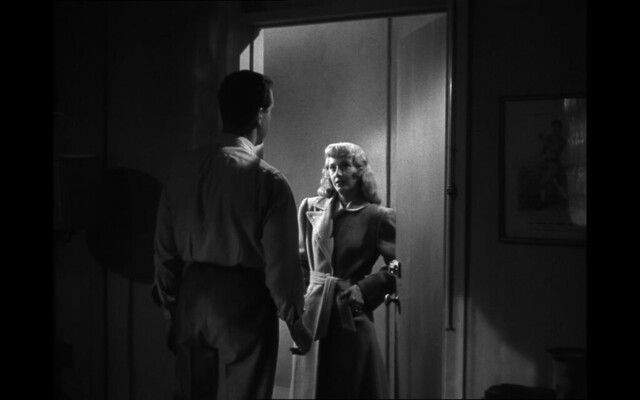
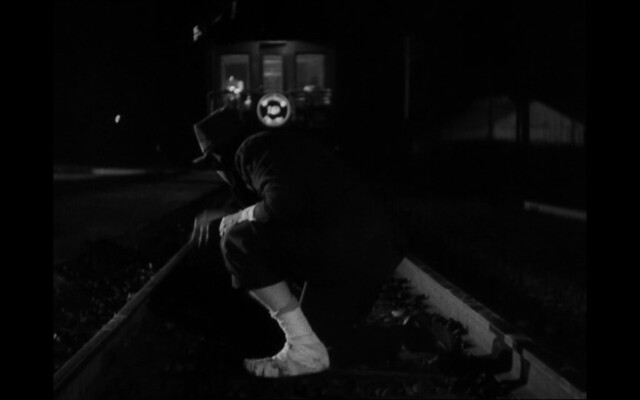
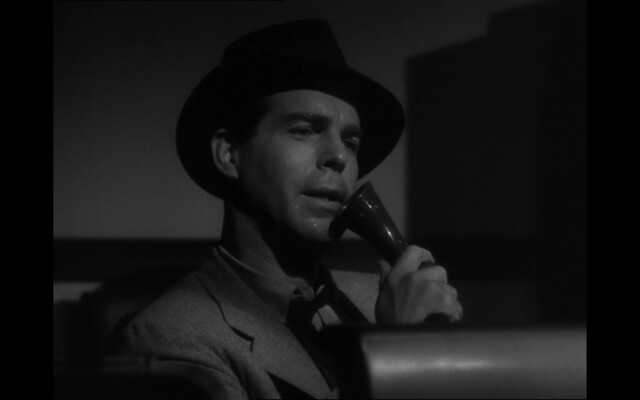
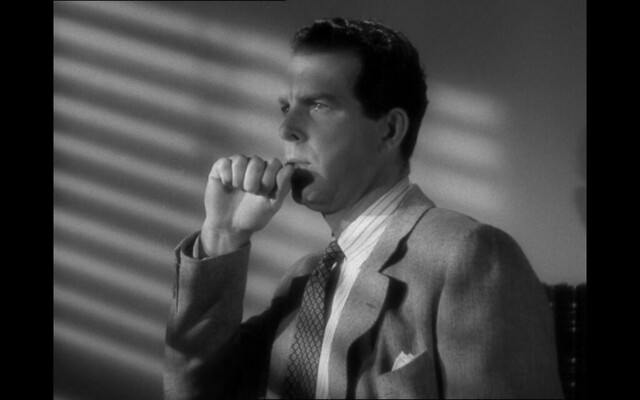
This is an intensely dark film, perhaps the first that truly earns the title of noir in every sense. Many of the scenes are so visually dark that screenshots are infeasible - night-for-night outside shots, night-time inside shots where the curtains get closed and the lights turned off; sometimes the only reference points are the glitter of an actor's eye or the streetlights outside the windows. And the story is certainly the darkest we have seen thus far on our noir travels - where cold-blooded murder can be committed for nothing more than money and the hallmarks of love can be manufactured and thrown aside as easily as a ten-cent tin of beans.


Barbara Stanwyck is a femme fatale formidable, the coldest and most focused yet. Her plans as exposed by Neff in the penultimate scene (in a room with all lights off and all curtains drawn) are the image of Brigid O'Shaugnessy's litany of murders and crimes done in the name of the Maltese Falcon as exposed by Sam Spade. But Phyllis Dietrichson's cold, calculating actions are infinitely more chilling than O'Shaugnessy's wildly opposing, emotional reactions to obstacle and accusation - Spade laughs at Brigid and never lets himself get taken in by her act, whereas Neff has been caught from the first in Phyllis's subtle web of desire and temptation. Where Brigid weeps and throws herself on the mercy of the men around her, Phyllis coolly manipulates them into positions that will be of most benefit to her. As femmes fatale go, Phyllis Dietrichson leaves all the others eating her dust.


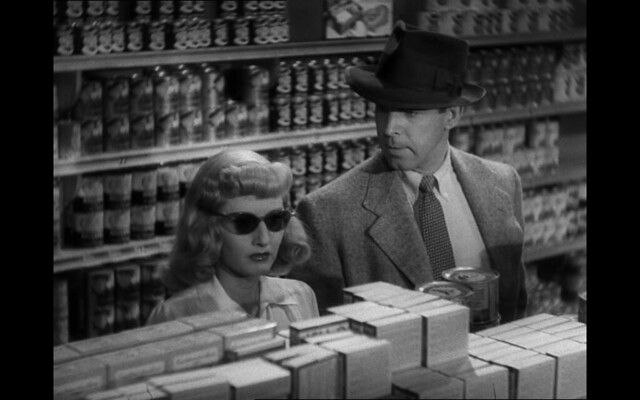
Much has been said about the supermarket setting, and I dare say much of it might be true - the brightly-lit can-stacked aisles provide about as much contrast to the pitch-black Old-Hollywood mansions and insurance offices as is possible on celluloid. Placing his noir characters in a public, family space, in broad daylight, Wilder highlights their absurdity compared to the everyday world - do things like this really happen? he seems to be asking the viewer, almost reassuring them.


Not in our comfortable world of baby food and tinned beans, no sir. This American dream is enough for all of us… or is it?


Blahblahblahtoby review

The first time I saw Double Indemnity I was stunned by the sheer weight of its ending, a thoroughly downbeat way to finish a film despite knowing right from the start that what we are watching is one man's dying confession.


Directed by Billy Wilder, this is one of the master's early efforts, six years before Sunset Boulevard opened an incredible decade of films from him and with a screenplay written by pulp fiction great Raymond Chandler based on fellow legendary pulp writer James M. Cain's novel this film has so much going for it on paper that it's no surprise that it has become known as one of THE great films of Hollywoods golden era. Currenty ranked #54 on imdb's Top 250 its reputation precedes it and as such some are disappointed when viewing for the first time.

But in so many ways this is a perfect example of the films noir cycle. The perfect murder for money and a woman that inevitably goes wrong, the cunning and conniving Barbara Stanwyck who leads MacMurray astray, location shooting at night, a knowing narration from the hard boiled protagonist, subtle homoeroticism, the inevitable betrayal and death of the protagonist, a fatalistic tone throughout and snappy dialogue all contributing to this film being rightly lauded as such.


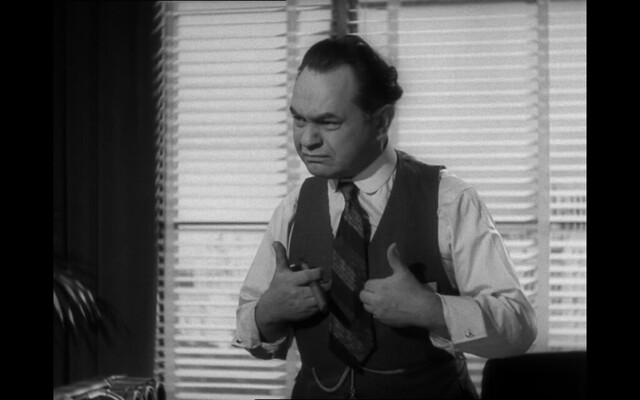
Aside from the atmospheric lighting and camera positioning that Wilder and his Director of Photography John F. Seitz worked hard to produce, providing the fatalistic tone of the piece; my favourite part of the film is the performance of Edward G. Robinson. His character of chief claims investigator Barton Keyes is a wonderful creation, filled with personality that only someone as talented as Robinson could do justice to. His “little man” inside him could quite easily have become something silly and campy in the wrong hands but this great actor steals the film from third billing as Neff describes the actions of his boss to us in flashback. The fact that the flashback scenes are from the point of view of Neff highlights the homoerotic nature of his relationship with the romanticised figure of Keyes and makes the explicit “I Love You” ending acceptable to the viewer in the Hays Code era of Hollywood production, they’re very close friends after all.

As far as motifs go there is a clear use of the Middle Class Murder and Sexual Pathology signifiers with Stanwyck as arch black widow chasing the money and not caring how many men she ruins along the way and MacMurray opening the film with “Yeah I killed him, I killed him for money and for a woman. I didn’t get the money and I didn’t get the woman. Pretty isn’t it?”


There’s some interesting sub-plots including a relationship with the young daughter of his victim, Lola Dietrichson (obviously an homage to The Blue Angel’s Lola Lola played by Marlene Dietrich) and some extremely tense moments that if this were any other film I might feel the need to way lyrical about but Double Indemnity should need no further praise; it’s a classic, enjoy it for what it is and take great pleasure in the Chandler dialogue and double entendres in the first part of the film.

How do you feel about this movie? Are you in agreement with the classic tag? Has it been wrongly praised and sat on too high a pedestal? Leave some blah below, let us know how you feel and don't forget to come back next week for more from the Noir-a-Thon.

And now for some coming attractions