Showing posts with label graham greene. Show all posts

Thursday, November 22, 2012

Expendables UK Week - British Gangster Fiction

Expendables UK week continues with a look at some of the great fiction that highlights the behaviour of the British underworld and their internal conflict between good and bad.

Two-Way SplitTwo-Way Split by Allan Guthrie

My rating: 4 of 5 stars


I was beyond pleasantly surprised at just how bloody good this modern British noir was.

And I do mean bloody in multiple senses, Allan Guthrie pulls no punches in his incredible debut that owes as much to Derek Raymond as he does to James Ellroy. I was hooked from the start by his triple threaded narrative, centred around two days in the life of a convicted murderer working as a debt collector, three crazy armed robbers and the two (basically) amateur PI's that get involved in their lives, as a holdup of a post office goes wrong; reading at a furious pace as I tried to keep up with the full throttle, no time to breathe, narration. I spent the entire day at work itching to get home and finish it too.

The grim and dirty description of the working classes of Edinburgh was highly reminiscent of the depressing state of the London found in Raymond's He Died with His Eyes Open; the events depicted in this novel are not common place yet the scene is set so well that you unquestionably accept their reality in the world of Robin, Eddie & Pearce.

Much like the America portrayed in the work of Ellroy the characters feel like real people; conflicted, selfish, greedy, angry, liable to take unexpected actions in the face of danger and violence. I think there was only one truly good person in this book and they were killed right at the beginning. If you're not already anticipating a dark, unhappy piece of noir storytelling that fact should clinch it for you. Aside from not being a particularly nice bunch you're hard pressed to find a real protagonist too, in the sense of hero or anti-hero at least; there's no good guy, no black hat there's just Pearce a man who spent weeks sharpening a screwdriver to kill someone and Robin, an ex-mental patient who tried to rob a petrol station with a water pistol and thinks nothing of killing people. In the middle is thirty thousand pounds in a duffle bag.

Guthrie tips his head to the classics of the genre, his amateur PI Kennedy referencing his admiration for Hammett and Chandler et al several times throughout as his raison d'etre. One of only a few brief light moments in the text.

The conflict between Don and Robin (which I can't go in to without major spoilers) really detracted from the overall enjoyment for me and was the only real weak point that stopped me from awarding 5 stars. Whilst it was interesting and unexpected and quite an unusual twist (I felt like there was something similar in a classic noir novel but can't put my finger on which one I'm thinking of - another example of Guthries Golden Period schooling in the genre?) it didn't actually feel necessary and slowed the action down a little. Small thing to complain about overall from an otherwise massively enjoyable new discovery.

I'm going to put Guthrie alongside my other new favourite noir author Don Winslow (very high praise indeed) and desperately hope that his other work lives up to this superb debut.

Get CarterGet Carter by Ted Lewis

My rating: 4 of 5 stars


Tell him. Tell him, I'm f*cking coming!

Originally titled Jack's Return Home this 1970 novel from Ted Lewis is the story of Jack Carter and his return to Doncaster from London after the death of his estranged older brother. Jack is certain that it was murder and will have his vengeance in this life or the next.

Taking place between Thursday Night and Sunday morning there's no time to blink let alone breath as Carter tackles his problems at an unrelenting pace. Having as much in common with kitchen sink dramas such as Saturday Night and Sunday Morning as violent revenge thrillers like The Hunter the bodies still manage to pile up by the final page thanks to Carter's no holds barred attitude.

Lewis really captured the time and place with his prose, the description of working class lifestyles in Britain in the 70s painted in true grim light and the attitudes are guaranteed to shock in this age of cotton wool and insane politcal correctness. Not that I'm advocating violence towards women, rape, murder and mayhem, underage pornography, bent cops, paki bashing or anything else that takes place during these three days but I think ignoring the fact that it actually used to happen and still does happen is even more absurd than those who perpetrate such things; there's no revelling in the gruesome details, this is the true bleak reality of it and Lewis makes it clear that it's not a glamourous life.

Carter is a fascinating mix of hard case hitman, hard boiled hero, cocky geezer, frightened boy; regret filled and growing old, a little bit of Alfie, a major influence on The Limey and if Guy Ritchie hadn't read it he at least saw the movie before making Lock, Stock & Two Smoking Barrels.

Incredibly this novel was the basis for three movie adaptations but I think it's fair to say that none of them captured the true essence of the book. Michael Caine may have come closest in 1971 but having seen it a couple of times I know for a fact it was toned down and several aspects changed despite my having forgotten the entire plot by the time it came to reading the book. Of the two American versions I would recommend the blaxploitation version Hit Man over the Stallone abomination every time.

Ted Lewis died at the horribly young age of 42 but wrote several more novels after this one, I think after the brilliant promise shown in this novel I will have to check out more of his work.

Brighton RockBrighton Rock by Graham Greene

My rating: 3 of 5 stars


Greene's most famous work is a game of two halves

I think it might be fair to say that this one is only as famous as it is because of the excellent film noir starring the old man from Jurassic Park. That was a shocker for me I can tell you, Father Christmas as a stone cold killer. It's a fine book, an early entertainment with an obvious study of the effect of the Catholic church on man. But I was at the midway point when I realised that it was suddeny becoming less enjoyable to read. Greene starts to get bogged down in his dissection of dogme and loses his way. As Leah says, for an early work it's brilliant but he just hadn't developed his skills as far as needed to tell this story AND get his message across in an entertaining way.

Fred Hale, enemy of teen gangster Pinkie is in Brighton and scared for his life. Ida Arnold, brassy middle aged woman is out for a good time. The two meet and share a connection but before anything can come of it Pinkie and his gang have loosed Fred off this mortal coil. A decision of natural death is arrived at and Ida won't take this for an answer. An entertaining game of cat and mouse ensues as Ida starts to unravel the murder whilst Pinkie and his gang set out to remove the loose ends.

The opening half is a pure joy to read, I felt certain this was heading for a 5 star review. Ida Arnold gets a lot more game time in the novel than in the movie and she's a brilliant character despite her obvious nature as a caricature of the British working class woman. Her affection for all things esoteric plays off against the Roman Catholic position of Pinkie who firmly believes in the fire and brimstone of Hell but isn't sure somewhere as wonderful as Heaven exists. In some ways it's a tale of good vs evil and right vs wrong but thanks to Greene's skill (and most likely his own doubts about his Catholic faith) the lines blur, positions alter and nothing (as in the real world) is that clear cut.

The young girl Rose, who is a witness that Pinkie must take care of, is perhaps the most complex of all the characters floating around the dirty underbelly of gentile Brighton. Despite the repeated assertions of everyone else involved that she is an innocent simpleton she is a conflicted young girl who questions everything and yet sticks to her passions and decisions despite knowing she's wrong.

The shift point occurs as Ida is less involved in the story and Greene focuses more on Pinkie, it no longer works as a tale of wits, a mystery, a noir investgation but a study of morality and Pinkie's mind is not one you really want to see in to. He's one of those guys with one thought and one thought only.

I'm glad I've finally read this but it's not one I'll go back to. Although now I have read it I can happily criticise the abomination that was the recent movie adaptation with even greater confidence. What a complete waste of the great source material and the wonderful original movie. Shame on you Helen Mirren.

View all my book reviews

Anyone read any really good books about British gangsters? Let me know in the comments.

Tuesday, October 4, 2011

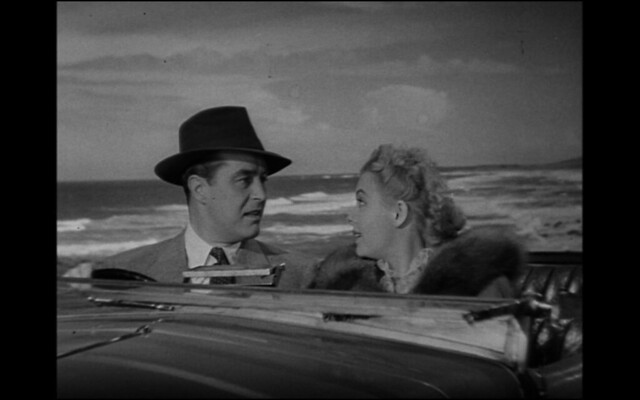
Noir-a-Thon: Ministry of Fear (1944)

Moving our Noir-a-Thon on to the second of the Graham Greene adaptations, Ministry of Fear is directed by the man behind classics such as Metropolis and M, Fritz Lang. You can find the Noir-a-Thon vault here.


Director
: Fritz Lang
Starring: Ray Milland, Marjorie Reynolds, Dan Duryea
Year: 1944
Country of origin: USA
Language: English

Synopsis: Ray Milland inadvertantly gets drawn in to a Nazi spy ring at an English County Fair and doesn't know who to trust as he tries to clear his name for murder and reveal the spy ring to the police.


What Indie Nights? review

Greetings BBBG readers, it's Leah 'I'm-running-out-of-ways-to-introduce-myself' from What Indie Nights?. I suppose 'from What Indie Nights' is a good enough way. Maybe I should just start introducing myself with a random fact - did you know that in England that if someone doesn't die within a year and a day of another person intentionally harming them, it can't be called murder?

Of course you didn't.

Ministry of Fear (1944)

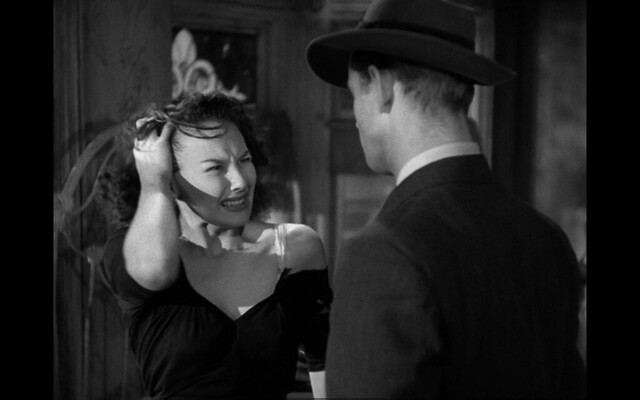
And as I sit here, drinking cold chocolate (it's like hot chocolate, only when the person making it was too lazy to heat up the milk) and thinking about Ministry of Fear, I wish it weren't true, because Fritz Lang intentionally harmed me with his adaptation of Graham Greene's wartime novel and I think I died a little inside.

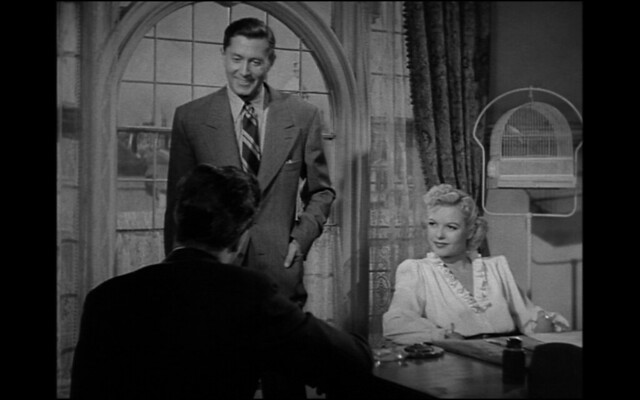
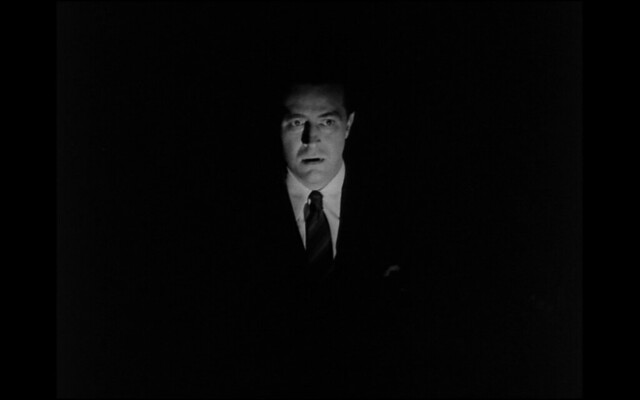
Ok, ok, I may be being a little hyperbolic, but truly, that movie was no noir, and it was a pretty poor example of any genre. As Toby will tell you, there are some lovely scenes, but they're lost in the drab, uninspiring story and confusing characters - including one bumbling private detective (there's your first clue, folks, that one's a big noir no-no) who lets his client come with him on a stakeout and then doesn't appear again for the whole film. I like to call him Mr. Plot B. Device, P.I.

Ministry of Fear (1944)

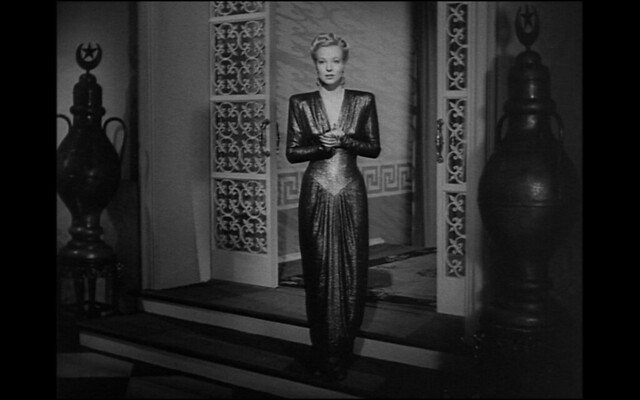
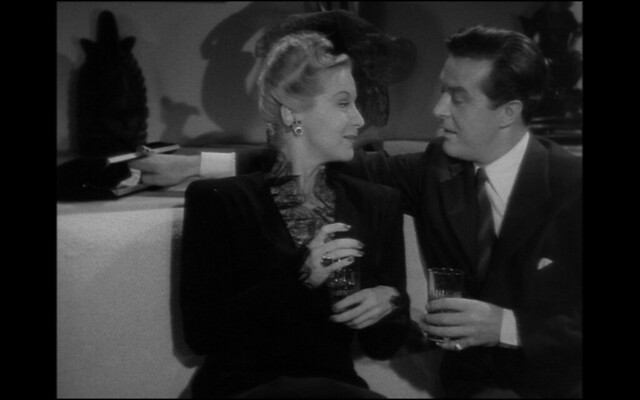
Firstly, and I know we (or especially, I) harp on about this a lot, but there's no femme fatale. At all. There's one American actress pretending to be an Austrian refugee with a 'brother' who looks a lot like Joel Cairo from The Maltese Falcon (another clue!) and behaves like butter wouldn't melt in his mouth.

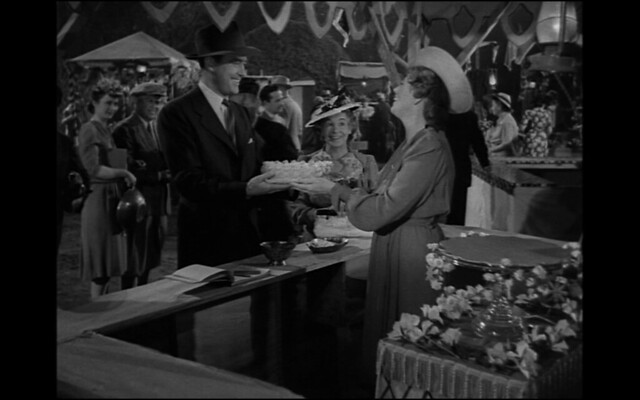
Our hero is an ex-mental patient who's about as tough as a kitten rolling in sparkly pink sugar and with much less charisma - the poor soul won't look at another cake for the rest of his life after the dreadful events following his release from hospital! Just imagine - you're mistaken for another man and given a secret code that wins you a cake at a country fair - terrifying so far - and are then pursued in a gentlemanly manner by a faux-blind old codger who crumbles your cake before your eyes to find - what? The real eggs with which said cake was made? The audience's engagement with the story? Nope, it's the MacGuffin, of course. To top off this really traumatising experience, a man is apparently shot during a relatively unrelated seance and you're framed for the crime! Now you have to go on the run, trying to avoid capture as well as discover just what made that cake so delicious- er, I mean, dangerous. Wouldn't you be afraid of cake forever, too?

Ministry of Fear (1944)

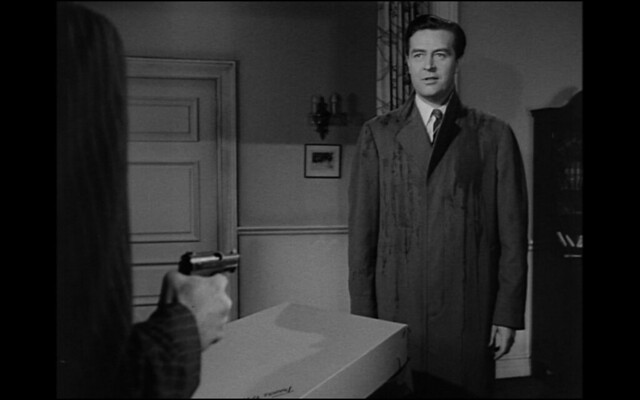
Sure there were a lot of characters with shady motives, but none of them were really characters, more like occasional pieces of dialogue spoken by pieces of furniture. Someone got double crossed, I think, but I'd struggle to tell you who. There was no real sense of threat to our hero, the crimes committed take second place to watching Marjorie Reynolds flutter her eyelashes, and we're left with a sense of general confusion and malaise. I guess what I'm trying to say here is that the movie was out-and-out silly, pretty boring and totally devoid of suspense or atmosphere.

Ministry of Fear (1944)

Now the most disappointing thing for me: I've gone on record as a Graham Greene devotee, so I suppose you can take or leave my opinion on this one depending on your view of things, but the man could write atmosphere and subtle nuances even if he had to write a microwave manual (the microwave would have a shameful past and end up reconsidering its faith in Microwave-God whilst making astute and poignant observations about its own mechanisms) and it's a crying shame to have his work butchered like this.

Ministry of Fear (1944)

Until next time, fellow travellers on the path of noir, and let us hope it's a better next time...

Blahblahblahtoby review

I've been struggling to find thoughts for this review. It's a film that is possibly as convoluted as the genre gets with very few redeeming features. Fritz Lang, the master film maker himself directed this and it was seemingly, loosely, based on Graham Greene's novel of the same name. Aside from those names I'm pretty much stumped. If you thought I didn't like Laura last week (which I did by the way) then you will probably think I hated this one.

The adaptation is quite a drawn out proposition, with apparent crosses and double crosses, misunderstandings and lies littering the course as obstacles for our hero to overcome within the 88 minute run time. Which is fine in a film noir if you care about the characters or the storyline but in this instance you don't learn enough about any of the characters beyond what's required for the plot to continue and the story is told in nothing more than plot points, moving gracelessly from one scene to another.

Ministry of Fear (1944)

I haven't read the original novel so I cannot compare the two but this has all the hallmarks of a bad adaptation, not least because there are none of the usual qualities of a Graham Greene story such as the study of humanity or human behaviour.

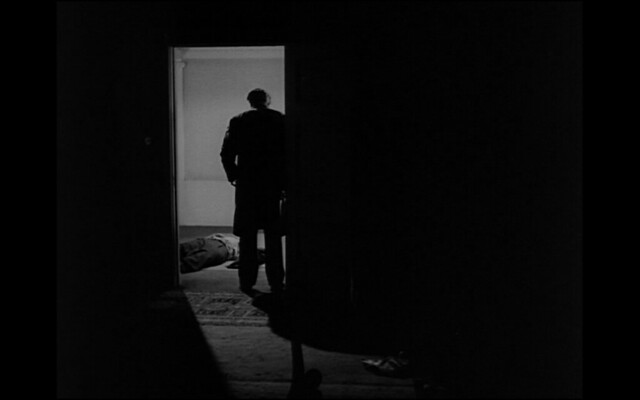
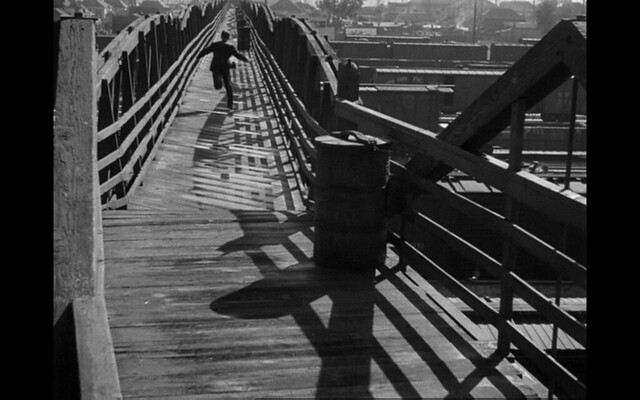
This is probably the worst of the Fritz Lang movies I've seen, his direction isn't bad, in fact there are some great visual moments such as shooting somebody through a door from a dark room but they're lost on a movie as unentertaining as this and watered down by the fact that at no point do you believe that this is happening in Central London, during The Blitz. It is not grey or oppressive, people are not concerned with the bombings or even the war at all, it's a terrible Hollywood recreation all the more offensive as the film was made during WWII.

Ministry of Fear (1944)

If you've seen the end of the theatrical version of Blade Runner then you've seen the end of Ministry of Fear, it's hard to say which one is worse. In Blade Runner it's an awful addition to a good movie but in Ministry of Fear it's an awful addition tacked on to an already poor movie.

On to categorising it within the noir motifs so I can concentrate on, hopefully, a better noir next week. This was a simple On The Run story with not so much gangsters in place of Nazis/Commies but actual Nazis. And worst of all, there's a happy ending. A very happy ending. Complete with the kind of dialogue and gurning more at home in a slapstick comedy.

Ministry of Fear (1944)

This film doesn't actually appear in the Film Noir Encyclopedia, which leads me to believe that it may not even be a film noir. I admit my judgement may have been clouded during my research by the fact that this was an adaptation of Graham Greene by Fritz Lang, a combination I couldn't resist. I think I deserved better!

Seen it? Disagree? Were you also disappointed by the adaptation? Graham Greene fans this is a call to arms! Leave me your blah below.

And now for some coming attractions


Tuesday, September 20, 2011

Noir-a-Thon Double Feature Part 1: This Gun For Hire (1942)

After last weeks washout with The Glass Key we move on to another great adaptation of the eras crime literature, this time English master of literature Graham Greene sees his 1936 novel A Gun For Sale adapted for an American audience as the 1941 film This Gun For Hire. Don't forget you can find all the Noir-a-Thon entries in our vault.


Director: Frank Tuttle
Starring: Alan Ladd, Veronica Lake, Laird Cregar, Robert Preston
Year: 1942
Country of origin: USA
Language: English

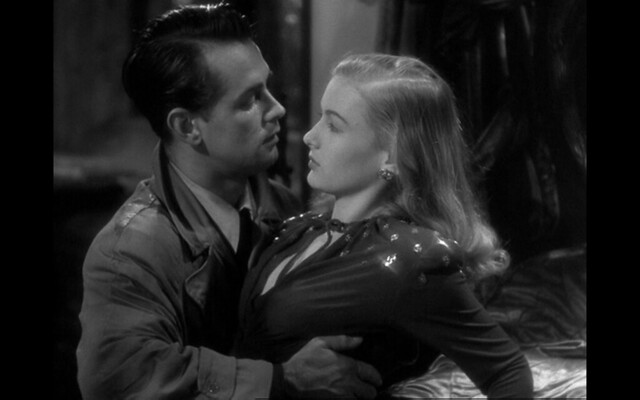
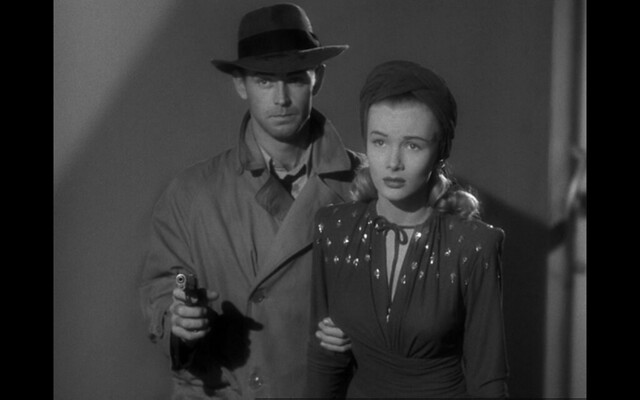
Synopsis: Hitman, The Raven (Alan Ladd) is hired to kill a blackmailer and then set up to take the fall. Pursued by the police he sets out to escape capture and get even with the pair of bad guys who intended for him to get busted. Along the way he encounters a cabaret singer, Ellen (Veronica Lake,) employed as an undercover agent by federal authorities.


What Indie Nights? review

Hi there BBBG faithfuls! It's nice to see you again!
Thanks for sticking with us over the unplanned hiatus of the last week or so, sometimes all one's self-imposed pressures and deadlines can just pile up too high to see over.

We're back in action again this week, looking at This Gun For Hire, another adaptation from a novel of the same period - this time it's Graham Greene. I will now go on record as being a complete Graham Greene fangirl: there's something about the world-weary poignancy of his characters, the sigh-and-get-on-with-itness of their outlook, that really appeals to my narrative sensibilities. I always like to say that his novels are just long, bittersweet endings to stories that began long before we as readers (or viewers) pick up the thread.


Having a strong background in Graham Greene 101, many of his trademarks are easily spotted in This Gun For Hire - a young girl out to meet the world, an old man reflecting on his part in it, young hopefuls pitted against its cruelty, young cynics battling on through it; the general bent of characters is towards introspection, creating deeper characterisations and relationships than many other films of the era. Greene's overall tone is unmistakeable, no matter how much the setting and characters have been shifted - it's not surprising that this is only the first of his stories appearing on our noir list.

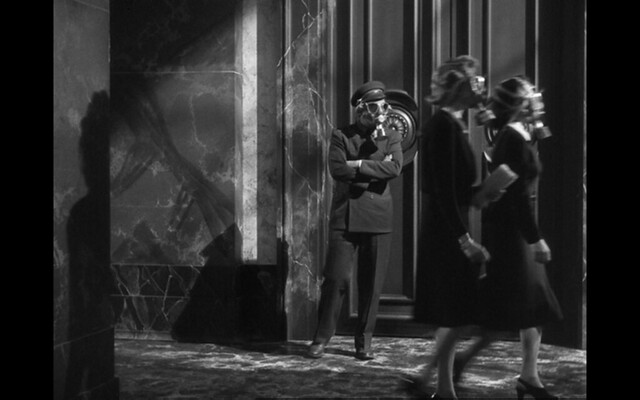
Interestingly, this is the first noir to feature any mention of the War that had been going on for nearly three years, although The Maltese Falcon was filmed only a year previously, and Pepe le Moko was filmed in Europe only two years before war broke out. It's here we see the beginning of the true American noir cycle, where the war can no longer be brushed off as a distant European problem - it begins to feel 'close to home' in a way that must have been extremely unsettling to Americans still feeling the effects of the Depression. The excellent denouement in the wide marble hallways of a Los Angeles chemical firm features mistaken identities due to the company-wide gas-mask drill, a scene that probably had a lot more meaning for the English readers of Greene than the American viewers of the film.


However the moralistic ending feels rushed, Alan Ladd's sudden change of heart after being persuaded by Veronica Lake to do the right thing for his country seems almost incongruous, or perhaps even beside the point - not for a noir anti-hero the nationalistic sentiments, the with-us-or-against-us attitude. He's been wronged his whole life, and he craves revenge.
That he gets it whilst still doing a good deed may have satisfied the morality censors of the time, but it doesn't quite fit with the self-serving attitude we expect from our anti-heroes. We might be able to see Raven's final deed as a mixture of Pepe le Moko's desperate caged-animal finalé and Sam Spade's sense of right and fair.
But one can't help thinking that Spade would never have played the sap, not even for his country…


Blahblahblahtoby review

As with most of the great classic period films noir This Gun For Hire is based on the thrilling fiction of the era; this time famed English literary master Graham Greene saw his 1936 novel adapted for American audiences in 1941.

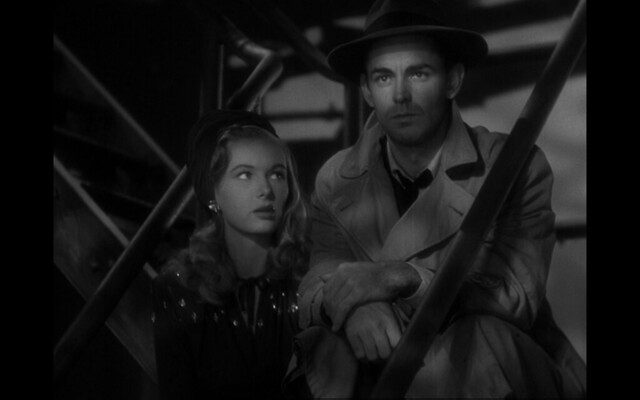
Alan Ladd as The Raven is one of the great early noir protagonists, a man who would beat a woman because she kicked his cat and then apologise by buying her a designer dress, a man who shows so little emotion and compassion for others but is hiding a dark and disturbing past which when relayed allows us an insight in to his character and makes his behaviour almost understandable.


Foreshadowing later noirs such as Melville’s excellent Le Samourai, as a man he exists in solitude, his trenchcoat and fedora a uniform worn with pride, not hesitating to remove any obstacle between himself and freedom.

Laird Cregar as the effeminate Willard Gates, responsible for the set up of our antihero, is a much more palatable version of the Sydney Greenstreet character from The Maltese Falcon, relying less on caricature and a bit more on the subtlety of character and performance to establish his role in proceedings.


Whilst Veronica Lake is the femme fatale without intending to be, she isn’t evil, she is working for the good of her country but still leads The Raven to his inevitable demise with a flutter of her eyelashes and an appeal to his hidden better nature as only a beautiful woman with her own agenda in a noir film could achieve.

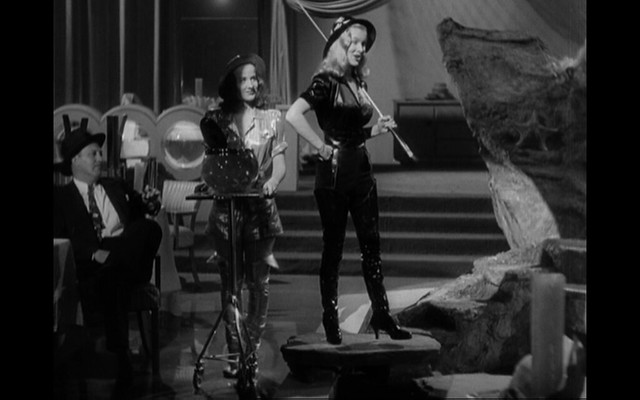
Blending location shooting with studio back lots you are treated to a some of the noir staples; late nights and expressionistic lighting in dirty looking locations such as a gasworks and sewer during a particularly enjoyable late night chase scene, together with some simple Hollywood musical numbers including one rather racy fetishistic fisherman/mermaid scene.


From the point of view of the noir motifs this is a film that is obvious with its wartime propaganda (Mr Big is in bed with the Japanese, selling chemical secrets.) But it also makes use of the Cops vs Robbers angle and the On The Run motif as The Raven looks to escape the police by fleeing the state but inevitably submits to his fate.


In much the same way I saw Shanghai Express as entertaining but Pepe Le Moko as a more rewarding viewing experience the comparison can be made of the two early noirs chosen for the Noir-a-Thon. This Gun For Hire is an entertaining early noir, it doesn’t have the shine or gloss or fast talking exposition of The Maltese Falcon. In the pairing of Alan Ladd and Veronica Lake (in roles that made them Hollywood stars) you get a highly charged affair which leaves you expecting one thing but delivered another, this coupled with the powerful sense of doom that surrounds The Raven, despite his best efforts to continue living, make for a highly rewarding viewing experience.


Seen this one? Got any other favourite Alan Ladd performances? Disagree with us skipping The Glass Key? Leave some blah below and tune in later for the second part of this weeks double feature, Double Indemnity.


And now for some coming attractions