Showing posts with label book review. Show all posts

Tuesday, May 14, 2013

Book Review: A Single Man by Christopher Isherwood (1964)

This is the Isherwood we have been waiting for, it seems to me his best novel. - Graham Greene


A Single Man by Christopher Isherwood

Rating: 5 of 5 stars

Blurb: In this brilliantly perceptive novel, a middle aged professor living in California is alienated from his students by differences in age and nationality, and from the rest of society by his homosexuality. Isherwood explores the depths of the human soul and its ability to triumph over loneliness, alienation and loss.

Thoughts: Christopher Isherwood has written a book that makes me hate him. Or maybe I hate myself? The main theme of this book is loss; loss of a lover, loss of youth, loss of identity, loss of direction, it's all there in beautifully phrased observations and it tickled that spot in my mind, the spot where I hide all of my fears, until I could no longer ignore the fact that I am and I continue to lose these things myself until one day the devastating and unthinkable will happen and I will lose that which I hold most important. It's not my hair, for once.


“The prefect evening...lying down on the couch beside the bookcase and reading himself sleepy...Jim lying opposite him at the other end of the couch, also reading; the two of them absorbed in their books yet so completely aware of each other's presence.”

Isherwood's novel demonstrates how repressed my fears are, and so does my natural reaction of making a silly joke about my hair. This book does this to me and whilst I love that I am seen reading such wonderful literature on a train when either side of me are people with the latest mega bestsellers with no words bigger than two syllables and all the feeling of my hand after I've slept on it all night, I'm not sure I am mature enough (or willing) to deal with the consequences.


“Think of two people, living together day after day, year after year, in this small space, standing elbow to elbow cooking at the same small stove, squeezing past each other on the narrow stairs, shaving in front of the same small bathroom mirror, constantly jogging, jostling, bumping against each other’s bodies by mistake or on purpose, sensually, aggressively, awkwardly, impatiently, in rage or in love – think what deep though invisible tracks they must leave, everywhere, behind them!”

I didn't really want to discuss the fact that Christopher Isherwood was a gay man and that his protagonist is a gay man but it seems that a lot of people can't get past that fact. Top hits = GLBT etc. and perhaps when this was written it really was unique to write about a gay man AS IF HE WAS A NORMAL HUMAN BEING but to me George is not defined by his sexuality, he is defined by his humanity and as such that should really be the end of it. This is not a great piece of gay literature, this is a great piece of literature full stop. If that offends you I shall not apologise.


“No one ever hates without a cause....”

I feel that to discuss this book any further would be to ruin it for you, it is 152 pages of quite large font, all you need to know beyond this is that it's also an incredibly uplifting and life affirming day-in-the-life narrative.

Feel free to discuss the book, the movie, anything but gay bashing in the comments or tweet me @bbbgtoby

Tuesday, April 30, 2013

Book Review: The Declaration of Independent FIlmmaking by The Polish Brothers (2005)

The Declaration of Independent Filmmaking: An Insider's Guide to Making Movies Outside of HollywoodThe Declaration of Independent Filmmaking: An Insider's Guide to Making Movies Outside of Hollywood

My rating: 4 of 5 stars


"An independent film succeeds or fails on the choices of its creators. There is no safety net."

The Polish Brothers are my kind of filmmakers and this guide is my kind of beginners guide to making films. Honest, enthusiastic and filled with helpful tips.


As a first year film student we were prescribed The Guerrilla Filmmaker's Handbook as THE resource for making movies with next to no budget, even now it is a prescribed text at the university I am working at infact, but whilst that series is hip and trendy it misses out information that young people really need to know when contemplating how to proceed in their fledgling career as a filmmaker. The Polish Brothers Declaration of Independence should replace that text or at the very least work in conjunction with it. These guys have been there, fought the battle to make their dreams a reality, seen the horrors involved and gone back for more time and again and now their experience can be learned from thanks to this book.


Using examples from their first three productions, Twin Falls Idaho, Jackpot and Northfork, you are taken on a journey from concept to distribution that incorporates technical filmmaking advice with details of how a deal is made and encouragement to keep going through even the toughest of times. They have their own unique way of working and they readily admit that this book isn't foolproof but they are more than happy to share their working practices and help others achieve their dreams. If you want to be the next Michael Bay this guide might not be for you but if you have a desire to tell a heartfelt story and possibly go bankrupt then I recommend this book and the films of these brothers wholeheartedly.


I read it cover to cover because I had a real interest in what they had to say on the subject of filmmaking not because I am currently planning on making a movie. Some sections are incredibly dry and not necessary for casual readers but happily a glossary will make referring back to these lessons much easier in future when I have my technical head on. At other times it read like a production journal with fascinating and entertaining insights in to the goings on of a working movie production including how they came to get Nick Nolte involved in Northfork or how they made James Woods cry for example. Throughout I was reminded just how much I enjoy their work and now I appreciate it even more for the hardships that they endured in the name of their art.

And remember next time Zach Braff complains about creative control and being a true artist that to make a real independent film where the filmmaker is in charge creatively, one must sacrifice personal, financial, and physical well-being not just beg their fans for money via the internet or sell 15 second voicemail recordings for $150 a go.

Got a favourite film by The Polish Brothers? Read any other great books on how to kickstart your filmmaking career? Already a filmmaker and want to share your own advice? Comment below or tweet @bbbgtoby with #polishbros

Friday, April 12, 2013

Book Review: The Pirates! in an Adventure With 5 Books (2004 - 2012)

Gideon Defoe is the creator of The Pirates! series of books which was recently adapted in to an Aardman Studios/Dreamworks Animated film, The Pirates! Band of Misfits. According to urban legend/his official authory blurb thing, when Defoe bumped into a woman he had pursued during his time studying archaeology and anthropology at Oxford, they began chatting about what they were up to. Realising that his job temping for Westminster council was not going to win him any romantic points, he told her that he was writing a novel. She asked to see it, at which point he found that he really was writing a novel. His manuscript was originally circulated among friends, who photocopied it and passed it on until, eventually, it fell into the hands of a literary agent. Then they spent $60m on making a movie of the first one.

Here is a brief look at the series book by book for those of you unfamiliar with the work. It starts with a bang and then repeats the formula with varying success. Pretty typical book series pattern I'm sure you'll agree.

The Pirates!: In An Adventure With Scientists
The Pirates!: In An Adventure With Scientists by Gideon Defoe

My rating: 4 of 5 stars


Words To Consider Before Embarking on A Piratical Adventure With Scientists:

Lubber

Pirate

Ham

Starboard

Sloop

Galley


If you feel you are not yet ready to become entangled with these and other similar words you may want to spend a week in your local library's section on Pirates! for Dummies before picking this book up.

Aaarghh! That scurby knave, Gideon Defoe, is some sort of comedy genius, his debut novel reads like a Frankenstein's monster-type creation that is part Lemony Snicket, part Douglas Adams, part Terry Pratchett with a dash of Monty Python thrown in for luck. It is a wonderful celebration of contemporary and classic British humour with the added bonus of starring luxuriantly bearded pirates and upon completion I would describe my mood as (c) excitable.

There is a not so subtle scene featuring a wrestling match between a scientifically created Man-panzee and a human created "Holy Ghost" and asks important scientific questions such as "who is the tallest pirate in the world?" I especially liked seeing which pirates were selected to walk the plank in to shark infested waters and how the main theme of the book is ham.

For those of you love a map this one features two, one on the inside of each cover, helpful for discovering the location of "The Tent With An Out Of Control Teen" and how to avoid sailing in to that great big compass in the corner of the Atlantic.

This was recently turned in to a movie by Aardman studios and quite unashamedly I am here today to admit my only prior knowledge of this book comes from having seen that movie several times. It's quite brilliantly funny, being simultaneously completely different yet entirely the same as the novel, a rare feat and provides you with two entirely separate adventures to burst your sides over.

I've seen this sold as a children's book and I've seen it categorised as Young Adult but unless the version with the movie poster as it's cover is abridged in some way I don't think I would advise giving this to a child, teenagers perhaps, but not children; there are multiple deaths throughout (including a fair maiden who takes a cannon ball to the head) and a fair amount of running through with cutlasses. But a pirate adventure without several people run through by cutlasses would be like asking a pirate not to eat ham, cruel and unusual.

If you stumble across this in any format I assure you that you will have a great time and if you;re ever looking for a gift for somebody there's no way you can go wrong with a book about pirates with luxuriant beards, especially if they are the significant hipster in your life.


The Pirates! In An Adventure With WhalingThe Pirates! In An Adventure With Whaling by Gideon Defoe

My rating: 3 of 5 stars


Have at you, you scabrous coves! Here be humourous treasure as The Pirates! have an adventure with whaling that features that miserable old pirate Ahab.

Things you might learn about during this adventure:

Debt

Whale Conservation

Nantucket

Multiple uses for physeter macrocephalus

The migratory course of the accursed Great White Whale

How The Pirates! once had an adventure with a mosquito


All the things I said about the first book remain true for this one, Python, ham, Discworld, cutlasses, Snicket, 42, it's all there and this time it's a lot less episodic and more a case of humour squeezed in to the story of Moby Dick/desperately trying to avoid being sliced and diced by angry debtors who The Pirates! wish they'd never borrowed money from.

BUT it's just not as brilliantly stupid as the adventure with Scientists. There are a lot of belly laughs and it's still too rude to be suggested reading for children but it felt like Defoe had either run out of ideas or was desperately trying to be a bit sensible at times.

I am still looking forward to more adventures with The Pirates! especially as the list of titles listed as being available in the series include one with Jennifer Garner, one with the G.O.P. and one where The Pirates! get sexy. But first I shall move on to The Pirates! In An Adventure With Communists as it's the only one left in my local library.


The Pirates! In An Adventure With CommunistsThe Pirates! In An Adventure With Communists by Gideon Defoe

My rating: 4 of 5 stars


Avast, ye scurvy cur! The Pirates have returned in a further adventure to locate their missing prized ham in the silky folds of Karl Marx's bushy beard!

The Pirate Captain will astound you with his vast array of philosophical conundrums and entertain you with a book filled with both Wit! and Wisdom! You too can learn the true facts behind maintaining discipline whilst running a pirate boat, the existence of God and the Question of gravy stains!


This third adventure is filled with even more belly laughs than ever before. I was concerned that this might be one of those ideas destined to be ruined by ever diminishing returns, the same jokes regurgitated repeatedly to less effect, but Defoe has out Pythoned himself this time around, writing a story filled with brilliant imagery and wonderful facts told in a light hearted manner featuring characters that (quite surprisingly actually) seem to be growing from one adventure to the next. Marx, Engels, Wagner and Nietzsche are the notable guests this time around as Communists get blamed for drowning kittens, stealing valuable art, making women wear underwear and other assorted atrocities.

Remember folks life is like a big shanty. Everything will be fine so long as everyone sings in harmony. But if someone plays a duff note on the accordion or tries to break-dance at a sensitive bit, there there will be all sorts of trouble, mark my words.


The Pirates! In An Adventure With NapoleonThe Pirates! In An Adventure With Napoleon by Gideon Defoe

My rating: 2 of 5 stars


The Pirates! return in their fourth adventure, this time to a desert island to raise bees and argue with Napoleon. Only they seemed to forget to pack the humour in their suitcase for this trip.

Far from the gut busting, rib bruising hilarity of previous adventures this one barely raised a smirk, fatal to a series that relies on its humour to sustain interest through its meandering "plots" and absurd situations.

There was a four year gap between this and the fifth instalment, here's hoping Defoe recovered some of his wit and enthusiasm in that downtime.


The Pirates! in an Adventure with the RomanticsThe Pirates! in an Adventure with the Romantics by Gideon Defoe

My rating: 5 of 5 stars


Yes! Finally! Defoe blends his rapier like wit with an actual plot and finds success!


“Babbage's Three Laws of Difference Engines

First Law: A difference engine must have at least six cogs.

Second Law: A difference engine must be able to operate a loom.

Third law: A difference engine must be able to kill a man, should the mood so take it.”


Do you want to see Ruth squeeze ten ping pong balls in to her mouth? Would you like to witness a pie-chart that causes children to clap and laugh in delight? In this fabulous fifth adventure The Pirates! take to a boat that bled blood, win two tickets to a corpse factory and run around screaming "barnacle!" at every opportunity.

Hired by Lord Byron, Percy Shelley, Mary Shelley and Charles Babbage to provide exotic adventures containing romantic elements, mild peril and foreign travel whilst on a dull vacation to Lake Geneva The Pirates! sail from Lake Geneva to the Romanian mountains in their most exciting, not to mention humourous adventure yet.


“You don't know what it is to live and laugh and love and run a man through! You've never tasted salty air on your tongue or waved heartily at a mermaid!”


If you were to take a poll of people reading you might find a lot of votes for great use of ham in a nautical setting, there may even be several readers who enjoy the excellent names created for the motely crew of pirates but guaranteed that majority will tell you that the best bit about reading a book about The Pirates! is all the running through that happens. Just ask Jeffrey Keeten about the time he ran a man through for daring not to wear a fencing cup in school colours if you are unsure of the unique pleasures a good running through can provide.

In true Defoe style this adventure meanders from one absurd moment to another but almost as if the five years away provided more than a huge paycheck from Dreamworks/Aardman studios, a refreshing break from what appeared to have become a dull chore for him and a chance to stock up on ham anecdotes, he must have studied with Robert McKee and managed to create a working plot and stick to it. I never had a real problem with his lack of plot before but when it appears from nowhere you realise what you;ve previously been missing.

Fear not Pirate lovers, this might be the fifth Pirates! book but it is not essential to have read them in order, if you have a willing seadog spirit begging to taste the salty air of a piratical adventure in the tradition of Monty Python and Douglas Adams then jump right in here, chances are you'll be an honourary member of the pirate crew in no time. And remember:


“You can't reduce passion and flair and eating ham to numbers, sir!”

View all my book reviews

Friday, April 5, 2013

Book Review: All My Friends Are Superheroes by Andrew Kaufman (1999)


I was browsing the new release section of my local Indie bookstore last week when I came across Born Weird by Andrew Kaufman, another in a line of charming if a little hip stories that stretches back to 1999 with the release of one of my favourite book discoveries of 2012, All My Friends Are Superheroes. A very slight book it is filled with smiles and deserves to be read by everyone, a truly charming romance. So I dusted off an old book review to give you a little nudge.

All My Friends Are Superheroes by Andrew Kaufman

My rating: 4 of 5 stars

Blurb: All Tom's friends really are superheroes.

There's the Ear, the Spooner, the Impossible Man. Tom even married a superhero, the Perfectionist. But at their wedding, the Perfectionist was hypnotized (by ex-boyfriend Hypno, of course) to believe that Tom is invisible. Nothing he does can make her see him. Six months later, she's sure that Tom has abandoned her.

So she's moving to Vancouver. She'll use her superpower to make Vancouver perfect and leave all the heartbreak in Toronto. With no idea Tom's beside her, she boards an airplane in Toronto. Tom has until the wheels touch the ground in Vancouver to convince her he's visible, or he loses her forever.


Thoughts: This book is totally adorable. It's not going to change your life, it's not Earth-shattering prose, it's just plain unadulterated pleasure to read.

I wish I could've finished it in one sitting but it's difficult to finish 107 pages on the bus journey to work. But then again if I had finished it without pause I wouldn't have known what it was like to put it down and feel the need to pick it up again.

There's not much I can tell you without spoiling it BUT it is a wonderful love story AND the superhero metaphors work really well 98% of the time.

To list some comparitive adjectives may be the simplest way to review it: funny NOT hilarious, nice NOT brilliant, short and sweet NOT epic and overly descriptive, playful NOT absurd.

My least favourite aspect are the short interludes where Kaufman introduces some other superheroes, most of which are trying too hard to be funny and fail completely and I do mean eye-rollingly bad attempts at jokes that might have been funny if i'd read this when it was first released in 1999 and I was 17.

Andrew Kaufman is Canadian. Maybe that explains things? In Canada he might be known for writing reality TV, perhaps the perfect medium for developing bizarre yet inherently real stories that have become his literary canon, so why not check out his other novels or an episode or two of Rescue Mediums when you get a few minutes?

View all my book reviews

Monday, March 25, 2013

Book Review: Fierce Bitches by Jedidiah Ayres (2013)

Fierce BitchesFierce Bitches by Jedidiah Ayres

My rating: 4 of 5 stars

Blurb: Across the border lies Politioburg: hell on Earth, home to putas, punks and psychos.

Escape is not in the stars, redemption is not in the cards, but reckoning might just be on the menu.

Stand back. The pit is about to spit something back out.


Thoughts: All you gringos listen up, Marias are some fierce bitches and they're gonna have their revenge for all the times you mistreated them. You had better hope they haven't read this call to arms from Jedidiah Ayres before you spit on them, slap them, cut them, and rape them or you may not have a face left for next time. Or any flesh for that matter.

Existing as some kind of awful halfway house between life and death, America and Mexico, heaven and hell, Politoburg is a shanty town created by a crime lord to house/contain/dispose of (delete as appropriate) you and your fellow low level underworld brethren. Populated by Ramon the bartender, a parade of Marias (hispanic hookers) and a revolving cast of degenerates, if you end up in Politoburg you'll soon learn that you've reached the place that, sooner or later, you will die in. And die people do, horrible violent deaths for the most part.

Jedidiah Ayres' prose is sparse and his tale is bleak as fuck, mirroring the carefully constructed locale and the unforgiving sun baked desert that surrounds it. This appears to be his first novella but its written with the skill and voice of a much more experienced man to the point that I wouldn't be surprised if this was Jim Thompson still writing after faking his death back in '77. Most impressive is his use of the second person narration, a device that can horribly backfire in the wrong hands but in this case was so perfectly done that I hardly noticed it until the chapter was over. Jedidiah Ayres where have you been all my life? This is the work of true master of the genre and I for one will be unsatisfied until there is an entire shelf filled with the man's work.

Jedidiah Ayres and Warren Oates, never seen in the same place at the same time.

This is another class release from Crime Factory Melbourne, a new specialist publisher who has recently entered my consciousness with a "buy whatever they put out" kind of statement. This one is a particularly beautiful classic looking publication and pretty much fits in the palm of my hand (for a mere $7 this is an essential paperback purchase people) but feel free to check out the recently loved Hard Labour and Lee, an anthology of stories inspired by the life of iconic actor Lee Marvin. All titles are now available for only $2.99 on Kindle from the Crime Factory Amazon store.

A Fuckload of Shorts is a collection of short stories by Jedidiah Ayres and published by Snubnose Press, one of which was adapted in to the micro budget film Fuckload of Scotch Tape.

View all my book reviews

Wednesday, March 13, 2013

Book Review: Lee by Crime Factory Publishing (2013)

LeeLee by Crime Factory Publishing
(featuring stories by Scott Phillips, Heath Lowrance, Johnny Shaw, Jenna Bass, Adrian McKinty, Jake Hinkson, Ray Banks, James Hopwood, Erik Lundy, Eric Beetner, Luke Preston, Nigel Bird, Ryan K. Lindsay, Andrew Nette, Cameron Ashley and Jimmy Callaway)
My rating: 4 of 5 stars


"I bet you're a big Lee Marvin fan aren't you? Yeah, me too; I love that guy." - Mr Blonde to Mr White in Quentin Tarantino's Reservoir Dogs.

I was watching Reservoir Dogs the other night and the second I heard that throwaway line again I knew that it was going to open my review to this collection of short stories about Lee Marvin. Sadly on opening the book I discovered that Mike White (not the actor/screenwriter but a different Mike White) had used the same idea for his introduction. Instead I shall quote the character Stillwell from the concluding story by Jimmy Calloway:
"Lee Marvin was always fun to watch, with that look on his face like he knew he could fuck you up if he had to but he'd rather not."

Lee Marvin at the Point Blank Wrap Party


As a prominent figure from recent pop culture history, everyone has their own image of Lee Marvin that is immediately brought to mind when his name is mentioned and it is his iconic status that the wonderful people at Crime Factory Publications (you may remember them from my recent gushing review of Fierce Bitches) have taken advantage of in commissioning this series of stories featuring the larger than life personality himself.


I don't know how much of each of these stories was based on hearsay, extrapolated from minor fact or just plain flights of imagination but the combined effect is that of the telling of fireside tales, of making Marvin in to a mythical being who lived hard, fought hard, drank hard and fucked hard and accepted nothing less from those around him.


All 17 stories are written by a different individual, in a different style and from differing points of view, they combine to tell of a full and crazy life, from 1944 on a hospital ship to 1987 as news of his untimely death by heart attack is heard by a young fan via many interesting, entertaining, bizarre and hardboiled events along the way. As his biographer, Dwayne Epstein, is quoted as saying on the cover, Lee Marvin is smack dab in the centre of the action where he belongs.

There's the time he turned down Jaws, the time he took a bullet for John Ford, the time Andy Warhol gave him PCP laced cigarettes, the time he needed a really big gun for shooting Point Blank, the time he hit someone, the other time he hit someone, the building he burned to the ground, the time he was arrested, the other time he was arrested, the time at the Oscars, the thing with Warren Beatty, the time with the boiling hot coffee, the time when he stole a car, but sadly no moment when Warren Oates could turn up and out crazy him.

It seems like every individual involved with creating this collection has a real affection for Marvin and that transfers to the stories told even when he's a painted as a total bastard. I had a blast from start to finish, making the decision not to get out of bed until the book was read, there goes Tuesday, and would highly recommend this collection to fans of film noir, noir fiction, Lee Marvin and jokes about Englishman, Welshman and Americans waiting to use a toilet. So get on over to Crime Factory and order your own copy of this excellent short story collection without hesitation.

Need more Marvin? Here's a Top 10 List to keep the fun coming.


View all my book reviews

Thursday, January 10, 2013

Fear and Nostalgia in the 21st Century: A Brief Overview of Hard-Boiled and Noir Fiction Part Four

The articles in this series were originally written for and posted at Literary Exploration.

There are literally dozens of great authors and great novels that could have been suggested as essential reading for this guide. The writer of the article went through agonising decisions over who to leave out and is more than aware that your favourite author probably hasn't been mentioned but feel free to start a discussion in the comments.

A (not-so-brief) Brief Overview of Hard-boiled and Noir Fiction

Part Four – Fear and Nostalgia in Los Angeles (1990s & 2000s)

There are currently many prolific authors working in crime fiction, whose names will not be mentioned, that occasionally find themselves labelled as noir by fans and critics alike and quite simply are not. They write about cops who have problems with their superiors or former military men with vengeance on their mind, they pile up the bodies and solve dark cases but they border on fantasy and as we’ve seen in the previous three parts to this overview true noirs are realistic and bleak with very few happy endings.

After assessing fifty years of noir and hard-boiled writing it becomes quite obvious that the fourth generation, the contemporary American hard-boiled and noir writer are yet to truly find their own unique voice or societal change to rail against.

If you accept that 9/11 changed the world completely in the same way that WWII and the threat of nuclear war did to previous generations we should expect a dramatic increase in distinct creative output from the next wave of authors.

What is clear is that, as with the rise in popularity of dystopian fiction, contemporary hard-boiled and noir authors are looking to their genre heritage and their countries past for settings and places to escape to. They are almost a lost generation, dreaming of a time when things were friendlier, less scary, less connected and invasive, that time when there was still some hope for the American Dream.

I discovered the work of Megan Abbott this year, she’s approximately 3 feet tall and specialises in reworking dark noir stories with a female centred twist. If you saw her on the street she'd probably be the last person you would imagine writing such dark novels. Her debut, Die A Little (2005), is set in 1950s LA and steeped in atmospheric suspense and voyeuristic appeal. She wrote four of these excellent period re-workings and then along came The End of Everything (2011) in which she updated her noir styling’s to teenaged girls in 1980s suburbia to amazing effect. It is a tale of lust, revenge, guilt, and my favourite four noir words; secrets, lies, passions and repressions.

Walter Mosley created the iconic hard-boiled hero Easy Rawlins in Devil in a Blue Dress (1990) and went on to write ten more books about his black private detective in the 1940s, 1950s and 1960s, ending with Blonde Faith (2007). Utilising the style of Chandler and MacDonald Mosley manages to craft top quality hard-boiled mysteries and blend them with analysis of the social inequalities of the time.

George Pelecanos is one of the most famous names from this list, especially for his time writing for the HBO series The Wire. He came to prominence however for his D.C. Quartet, a series of four historical crime novels set in Washington D.C.. He also created two fantastic hard-boiled series featuring first Nick Stefanos in A Firing Offense (1991) and then the pairing of Derek Strange and Terry Quinn with Right as Rain (2001) which has built him a reputation for his gritty depiction of street life and a focus on hard-luck criminals.

James Ellroy, the King of Sinnuendo, the Demon Dog of American crime writing, knows how to write bleak noir filled with hard-boiled characters like nobody working today. His work is generally set in the 1950s and 1960s, featuring densely plotted criminal behaviour from all sides of the law with his tone relentlessly pessimistic. Perhaps his best work (or at the very least the best place to start) is L.A. Confidential (1990) and should be followed up with the first part of his Underworld USA trilogy American Tabloid (1995). But nobody can describe him better than he describes himself:
“Good evening peepers, prowlers, pederasts, panty-sniffers, punks and pimps. I'm James Ellroy, the demon dog, the foul owl with the death growl, the white knight of the far right, and the slick trick with the donkey dick. I'm the author of 16 books, masterpieces all; they precede all my future masterpieces. These books will leave you reamed, steamed and drycleaned, tie-dyed, swept to the side, true-blued, tattooed and bah fongooed. These are books for the whole fuckin' family, if the name of your family is Manson.”
Another black private investigator, Lew Griffin, got his start in The Long-Legged Fly (1992) by James Sallis, a novel that starts in the 60s and moves through to the 90s and would lead to five more outings. Sallis has his own way of writing these hard-boiled private detectives, they’re complex and often poetic in their structure. He would go on to create another great of modern noir, Drive (2005) about an unnamed stunt driver who also works as a getaway driver for criminals.

Don Winslow might be most widely known for his brilliant and brutal modern noir Savages (2010) but he also created the surfing private detective Boone Daniels in The Dawn Patrol (2008). Winslow is known for his adrenaline-fueled novels and unique prose style, his subject matter is nothing ground breaking but he entertains like nobody else in the genre.

That leaves us with only Dennis Lehane to draw part four to a close. Lehane might just be best known for his psychological thrillers turned in to Oscar bait movies but his six Boston based noir thrillers featuring male/female investigation team Kenzie & Gennaro are some of the best in modern hard-boiled crime writing. Their first outing A Drink Before The War (1994) set a high standard to live up to but he reached incredibly bleak heights with Gone Baby, Gone (1998).

I'll reserve special mention for another Brit, Philip Kerr, the creator of the Bernie Gunther novels. These books are a fantastic throwback to classic hard-boiled novels. Bernie starts as a private detective in Berlin as Hitler is consolidating his power and witnesses some truly awful things. His first three adventures are collected as Berlin Noir (1989 to 1991) and are well worth your time.

You can find me discussing books on Goodreads, discussing movies on Letterboxd, tweeting nonsense as blahblahblahtoby  feel free to say hi.

Wednesday, January 9, 2013

The Times They Are A Changing: A Brief Overview of Hard-Boiled and Noir Fiction Part Three

The articles in this series were originally written for and posted at Literary Exploration.

There are literally dozens of great authors and great novels that could have been suggested as essential reading for this guide. The writer of the article went through agonising decisions over who to leave out and is more than aware that your favourite author probably hasn’t been mentioned but feel free to start a discussion in the comments.

A (not-so-brief) Brief Overview of Hard-boiled and Noir Fiction

Part Three – The Times They Are A Changing (1960s to 1980s)

It’s a terribly clichĂ©d expression to use as a title for this chapter I know but when looking at the evolution of hard-boiled and noir fiction it’s hard not to take in to consideration the fact that socially and politically America was in turmoil like never before.

In part two we acknowledged that the bleak outlook adopted by the second generation of noir authors, such as Jim Thompson, was a reflection of societal fears regarding Communism and nuclear war as they moved away from the prohibition era writing of Hammett and Chandler but as the 60s came around the audience for these books found themselves disconnected from the next generation who had radical ideas for changing the world.

The growth in popularity of television, the baby boomers, the Vietnam war, a President assassinated and that guy Nixon are just some of the major changes in American culture which saw the market for the bleakest noir fiction dwindle in size.

First there was the closure of several paperback original imprints whilst the ones that remained tended to focus on recurring characters rather than taking chances on original pulp work, then there was the splintering of the world of noir as it suddenly became a more diverse place. From the 70s onwards we’ve been treated to books about serial killers, forensics experts, hardened cops working within the departmental structure, and the redemption of the lone wolf. Not to mention females, homosexuals, non-whites and just about everything a writer desperate to stand out from the crowd could think of in between.

As mentioned previously several of the second generation of hard-boiled and noir writers kept writing after the death of the paperback original. Ross MacDonald’s Lew Archer and Mickey Spillane’s Mike Hammer were perfectly suited to repeat adventures throughout the 60s and 70s (Blue Hammer the 18th Archer in ‘76 and Black Alley the final real Hammer in ’96) and sat alongside the newcomers as wisened old heads ready to guide the next generation.

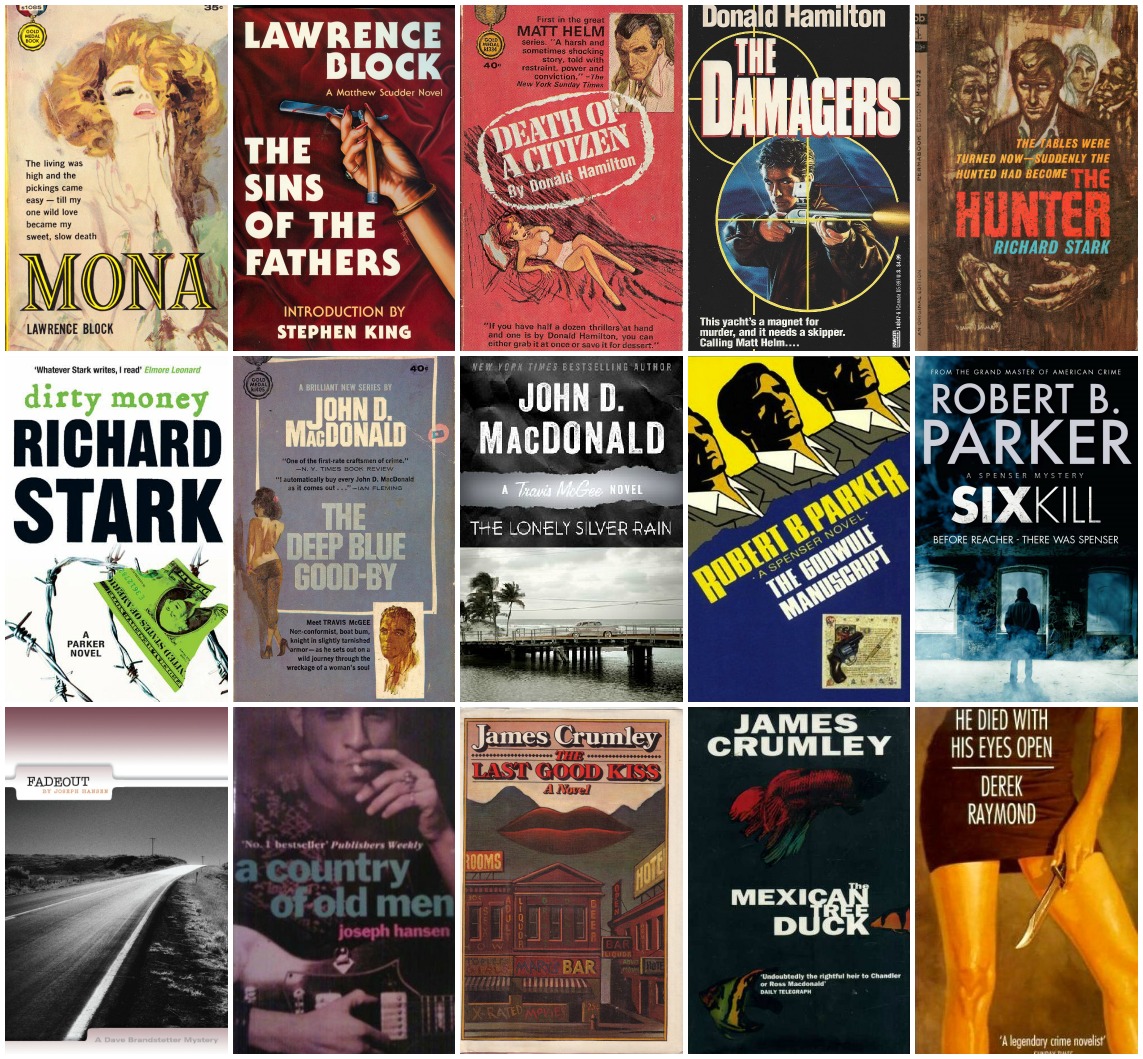
One of the most important names in the history of the genre is Lawrence Block, he got started writing short stories during the heady days of the paperback originals (some of which are collected in the highly enjoyable Lost Weekends and One Night Stands) and had his first novels published in the early 60s. Amongst his mixed bag of early work the superb and disturbing Mona AKA Grifter’s Game (1961) has the distinction of being the first novel republished by the excellent Hard Case Crime imprint. He is a man that appears to have adapted quite readily to the need for recurring protagonists with no fewer than six different series created by him since the mid 60s. The Sins of the Fathers (1976) marks the debut of perhaps his most popular character, Matt Scudder.

Swedish born American Donald Hamilton is someone that isn’t so readily known in the 21st century but his character Matt Helm was created for Gold Medal Books in Death of a Citizen (1960) and ran for 27 books until The Damagers (1993.) Helm is a no-nonsense kind of guy, working as an undercover counter-terrorist agent he narrates his escapades with a detached, dead pan style include the many fights, torture sequences and sexual conquests.
"Donald Hamilton has brought to the spy novel the authentic hard realism of Dashiell Hammett; and his stories are as compelling, and probably as close to the sordid truth of espionage, as any now being told."
Donald Westlake was an incredibly prolific author in the genre who used many pseudonyms to divide up his different work. His most famous being Richard Stark, creator of the hard-boiled Parker, a ruthless master thief willing to do whatever it takes to get what he wants. Parker first appeared in The Hunter (1962) and went on to star in a further 23 novels until Dirty Money (2008).

The Deep Blue Good-Bye (1964) marked the debut of hard-boiled detective Travis McGee. His creator John D. MacDonald would write one book per year until The Lonely Silver Rain (1985) brought the sequence to a close after 21 adventures. McGee is known for being a misogynist, a character that has dated quite badly and can easily offend some readers. MacDonald has an easygoing approach to the series, his detective lives on a houseboat and would prefer to lounge around drinking to solving crimes, that belies the intricate plotting he uses and misogyny aside this is a great series of third generation hard-boiled fiction.

Robert B. Parker wrote his Ph.D dissertation on Hammett, Chandler and Ross MacDonald and went on to create his own legendary private eye, Spenser in The Godwulf Manuscript (1973). Parker is known for his modern approach to the classics of the genre and including series characters from minority backgrounds as more than just punchbags for his protagonist. Sixkill (2011) was the 40th Spenser outing and was the last novel he finished before his death, making Spenser The Rolling Stones of hard-boiled fiction.

Joseph Hansen is best known for his ground breaking series of crime novels starring his most iconic creation, Dave Brandstetter, an openly gay insurance investigator who still embodied the tough, no-nonsense personality of the classic hardboiled private investigator type of protagonist. His first outing was Fadeout (1970) and he went on to appear in eleven more novels until A Country of Old Men (1991).

James Crumley is a self-declared heir to the Chandler tradition, he defines his own sensibility as conditioned by the disillusionments of the Vietnam War and his vision of justice less clear-cut. His protagonists are environmentalists and sustained by eccentric alliances with criminals and other misfits. Described as the literary offspring of Chandler and Hunter S. Thompson he was another author who found success outside of America long before the Americans took to him. His book The Last Good Kiss (1978) features the alcoholic ex-army officer turned private detective, C.W. Sughrue, as it’s protagonist and has been labelled as the most important crime novel of the last 50 years, influencing much of what will be described as the fourth generation of hard-boiled and noir writing. The Mexican Tree Duck (1993) is the only one of his novels to be acknowledged with an award.

I’ll now break my own rules and mention briefly the British author Derek Raymond. In 1984 he wrote the first book in The Factory Series, He Died With His Eyes Open, a book that seems to have captured both the hard-boiled spirit of Chandler and the blackest, bleakest noir poetics of David Goodis in one wonderful novel. Whilst he wasn’t American he is the closest I have found to true hard-boiled and noir fiction outside of America and deserves to be read by all fans of the genre.

Part four will bring us right up to date with a quick look at some of the shining lights in contemporary American hard-boiled and noir fiction.


You can find me discussing books on Goodreads, discussing movies on Letterboxd, tweeting nonsense as blahblahblahtoby  feel free to say hi.

Tuesday, January 8, 2013

The Case of the Paperback Original: A Brief Overview of Hard-Boiled and Noir Fiction Part Two

The articles in this series were originally written for and posted at Literary Exploration.

There are literally dozens of great authors and great novels that could have been suggested as essential reading for this guide. The writer of the article went through agonising decisions over who to leave out and is more than aware that your favourite author probably hasn’t been mentioned but feel free to start a discussion in the comments.

A (not-so-brief) Brief Overview of Hard-boiled and Noir Fiction

Part Two – The Case of the Paperback Original (1950s)

In part one we looked at the birth of the genre as a more realistic type of literature in reaction to the traditional whodunit from Britain. The cynical approach towards life of the protagonist summing up the attitude of the hard-boiled hero and how the worlds of noir novels are never happy places where things go right.

We looked at Hammett and Chandler and Cain, the three pillars of the style that all who followed evolved from. Now we move on to the second generation of hard-boiled men who took advantage of a new publishing idea and the post WWII atmosphere of paranoia and fear.

Fawcett publications created the Gold Medal Books imprint in 1949 with the idea of publishing pulp novels directly to paperback formats. Paperback originals were published for the first time under this new imprint and very quickly became the home of noir fiction, the dark brand of crime writing that would go on to capture the mood of the general public.

At the end of WWII a new fear was brewing in the minds of America; images of nuclear warfare were embedded on the consciousness of a generation of people and McCarthyism via the House Committee on Un-American Activities hearings instilled a previously unknown universal paranoia to the people.

These two key developments combined to provide a hotbed for bleak, raw, sleazy, deranged, violent, uncompromising, chilling, and warped, existentially horrific noir fiction with novels selling in excess of one million copies on a regular basis and spawning numerous copycat publishing imprints.

The first name from this second generation is one a lot of people are already familiar with, Mickey Spillane; his first Mike Hammer novel was I, The Jury (1947) and continued to write in to the 50s yet it wasn't until the end of the era that he really came in to his own. Kiss Me Deadly (1952) was the basis for the iconic film noir of the same name and serves as a great introduction to a protagonist who is a complete and unashamed misogynist, unafraid of offending anyone, in stories that you jump on and ride like the wind through intrigue, fist fights, witty dialogue, sexual encounters and the inevitable denouement.

The other name that regularly gets mentioned as the obvious hardboiled heir to Chandler and Hammett is Ross MacDonald. The Moving Target (1949) was the first appearance of Lew Archer, a PI that would last through 18 novels to The Blue Hammer (1976). This series longevity alone makes MacDonald stand out from the field of hard-boiled authors but the growth of the character and the evolution of writing style from Chandler copycat to a writer who was as comfortable with poetic imagery and psychological insight as witty putdowns and biting sarcasm marks him as one of the true greats of the genre.

Gil Brewer is something of a forgotten man but he was prolific and popular in his time, having over 30 novels published in the new paperback original format. But to those in the know Gil Brewer is a treasure trove of 50s noir goodness. His protagonists are ex-soldiers, ex-cops, drifters, convicts, blue-collar workers, charterboat captains, unorthodox private detectives, even a sculptor.  The plots range from searches for stolen gold and sunken treasure to savage indictments of the effects of lust, greed, and murder to chilling psychological studies of disturbed personalities. The Vengeful Virgin (1958) that was recently republished by Hard Case Crime and The Red Scarf (1955) are amongst the standout titles from his bibliography.

Another man you could make the same statements about is Day Keene, the pair seems to go hand in hand infact. Even more prolific than Brewer, Keene has left a lasting legacy of entertaining noir stories that occasionally border on genius. Hard Case have also reissued a Keene novel in Home Is The Sailor (1952), you may also enjoy To Kiss or Kill (1951) and Dead Dolls Don’t Talk (1959).

Charles Willeford is the author who found fame in the 80s with his Hoke Mosely series but he published High Priest of California (1953) at the start of the boom in paperback sales and quickly followed it up with Pick-Up (1955) whilst still enlisted in the air force. Charles Willeford, in his best works, puts art, aesthetic sensibility, critical acumen, morality, and American ideology on a dramatic collision course, he was known for his quirky nature and eccentric characters and his juxtaposition of humour and violence is said to have influenced a young Quentin Tarantino (but then what didn’t?)

The other big Charles of the period was Charles Williams and he really was a BIG Charles. In 1951 his debut novel sold over one million copies in a time when one hundred thousand was the norm and in 1953 he became the first paperback original to be reviewed by The New York Times. Widely praised by critics Charles Williams is to the paperback originals what Hammett was to the 30s. He is known for frequently satirizing his male protagonists' points of view, while implicitly reassessing the traditional genre figure of the femme fatale.

As mentioned previously about Woolrich, Williams was always more popular in France and only A Touch of Death (1954) and River Girl AKA The Catfish Tangle (1953) appear to be in print in English, a fact made even more shocking by the following statement made by pulp historian Woody Haut:
"So prolific and accomplished a writer was Charles Williams that he single-handedly made many subsequent pulp culture novels seem like little more than parodies."
David Goodis is perhaps my personal favourite from this period (again he is widely available in French but not so much in English) his novels depicting the bleakness and darkness of lives in free fall, his words a statement of frustration, telling tales of gloom, depression and despair. Noir at its blackest. Down There AKA Shoot The Piano Player (1956) and Cassidy’s Girl (1951) represent him at his peak.

I’ve saved the biggest name, arguably the best writer of the bunch and possibly the most prolific for last, Jim Thompson. There are no good guys in Thompson's literature; everyone is abusive, opportunistic, or simply biding time until able to be so. His style and prose elevated his work above well written genre pieces and in to literature which resulted in him being dismissed as just another pulp writer by those that read the paperback originals. The Killer Inside Me (1954), is perhaps his most famous work and represents the first time the reader was treated to an intimate portrait of a psychotic mind whilst The Grifters (1963) was his most successful movie adaptation.

Part three will take a look at the end of the popularity of paperback originals and what happened to crime fiction in the 60s and 70s.

You can find me discussing books on Goodreads, discussing movies on Letterboxd, tweeting nonsense as blahblahblahtoby, feel free to say hi.

Monday, January 7, 2013

A Not So Cosy Mystery: A Brief Overview of Hard-Boiled and Noir Fiction Part One

The articles in this series were originally written for and posted at Literary Exploration.

There are literally dozens of great authors and great novels that could have been suggested as essential reading for this guide. The writer of the article went through agonising decisions over who to leave out and is more than aware that your favourite author probably hasn’t been mentioned but feel free to start a discussion in the comments. 

A (not-so) Brief Overview of Hard-boiled and Noir Fiction

Part One - A Not So Cosy Mystery (1930s and 1940s)

In 1887 Arthur Conan Doyle created Sherlock Holmes and the success of his great detective spawned an entire genre of detective fiction that imitates to some degree or another to this date. The light-hearted and relatively straightforward approach towards solving crime reached its pinnacle in what has become known as The Golden Age of crime fiction, the 1920s and 1930s. The large majority of the authors writing in this popular style of fiction were British and this was reflected in the settings and general sense of manners contained within.

The inter-war years were a difficult time both socially and politically and this change in society saw crime fiction edge towards what was a more realistic, and more depressing tone with content that would almost certainly shock the characters found within an Agatha Christie novel. The pioneers for this movement towards realism were, perhaps unsurprisingly, Americans and this style became known as hard-boiled.

Taking its name from the style of preparing eggs that leaves the hard shell intact and the yolk fully solidified, the protagonists of hard-boiled fiction are tough skinned, street wise, sharp tongued and ready to solve a mystery with violence if necessary (and it almost always is.)

These are cops, private detectives, ordinary citizens coming up against prohibition gangsters, organised crime, crooked cops, and looking to stand up for what is morally correct. One lone man against an entire system; grown cynical and expecting the worst of people but hoping for the best, he’s the kind of guy who’s seen every horror and will surely see worse before he solves this case.
Hard-boiled is a naturalistic style of writing combined with a cynical, world-weary attitude. This evolved in to Noir fiction, a genre that is if anything even darker; it’s protagonists are usually morally suspect at best and at worst are degenerates, psychopaths and cold blooded murderers.

The most succinct and accurate definition of the difference between the two styles is this:
Noir is the world. Hard-boiled is the character. You can have Noir without the Hard-boiled, but not the other way around.
Carroll John Daly is credited with creating the first hard-boiled story for Black Mask magazine in the 1920s and his first hard-boiled novel Snarl of the Beast (1927) marks the first of, what I shall deem, the essentials of the genre. At the time Daly was the most popular author of the genre he essentially started but he has since been unfairly labelled a hack (the writers opinion only) for simply not being of the same quality as the famous authors he inspired.

Hot on the heels of Daly was Dashiell Hammett, the former Pinkerton operative turned author, who between 1929 and 1934 published the only novels he ever wrote. At least two of which are widely considered masterpieces of the genre. Red Harvest (1929) featuring the unnamed detective known as The Continental Op and perhaps his most famous work The Maltese Falcon (1930); it’s PI Sam Spade is credited as being the archetype that all other hard-boiled detectives are based on, with his personal detachment from the case and unflinching devotion to ensuring justice his strongest characteristics.

The man who would follow in his footsteps, Raymond Chandler, said of him:
“Hammett gave murder back to the kind of people that commit it for reasons, not just to provide a corpse...He put these people down on paper as they are, and he made them talk and think in the language they customarily used for these purposes.”

A more obscure name with an essential of the genre crops up next, Raoul Whitfield; his debut novel Green Ice (1930) was described by Dashiell Hammett as “280 pages of naked action pounded into tough compactness by staccato, hammerlike writing” but he never seemed to live up to his early success and retired from writing fiction only a few years later.

There are three names that everybody mentions when discussing this period of early hard-boiled American fiction. Hammett is the first, his Maltese Falcon regularly winning polls for best hard-boiled novel also, but to his name you will also find added the words Chandler and Cain.

Raymond Chandler decided to try his hand at writing after losing his job during the Depression and in the process seemed to capture America the way that America wants to be remembered. His hero is Philip Marlowe, his beat is L.A., a brave warrior in the Sam Spade mould but with a softer underbelly. In his classic debut The Big Sleep (1939) we find a PI who likes to drink, is handy in a fight and cynically wisecracks his way through most situations but this is also a man who plays chess, reads poetry and has philosophical questions playing on his mind. The generally acknowledge highpoint in Chandler’s (and Marlowe’s) career would come later with The Long Goodbye (1953) and demonstrates the literary nature of the genre, author and character.

James M. Cain on the other hand was largely active in the noir category; in his major works his characters were not detectives but men corrupted by sex and money. Double Indemnity (1943) is the story of an insurance agent who plots against his employers to get a woman and some money. The Postman Always Rings Twice (1934) features a mixture of sexuality and violence in a love triangle situation.

With the big names out of the way I will share two more important figures in the formative years of this genre that are a lot harder to find and therefore more obscure.

Cornell Woolrich, who also wrote with some success under the pseudonym William Irish, is virtually out of print today but his importance on the development of the genre remains. His work more often that not evoked despair and cynicism in the everyday life scenarios and as was the case with the bleaker examples of the genre was more popular in France than America. If you can find them, I recommend The Bride Wore Black (1940) and The Black Angel (1943) as good starting points.

Dorothy B. Hughes is another essential early noir author that few people have heard of. Her In A Lonely Place (1947) has recently been republished as a Penguin Modern Classic and quite rightly so, is a fine example of her tightly plotted and tense approach towards noir and features a truly heinous protagonist in Dix Steele. Amongst her other work The Blackbirder (1943) is a story of fear, paranoia and dread.

In Part Two I’ll be taking a look at the second generation of authors who worked during the boom in paperback fiction of the 1950s.

You can find me discussing books on Goodreads, discussing movies on Letterboxd, tweeting nonsense as blahblahblahtoby  feel free to say hi.

Friday, January 4, 2013

Book Review: Altered Carbon by Richard Morgan (2002)


Altered Carbon by Richard Morgan

My rating: 4 of 5 stars

Blurb: In the twenty-fifth century, humankind has spread throughout the galaxy, monitored by the watchful eye of the U.N. While divisions in race, religion, and class still exist, advances in technology have redefined life itself. Now, assuming one can afford the expensive procedure, a person’s consciousness can be stored in a cortical stack at the base of the brain and easily downloaded into a new body (or “sleeve”) making death nothing more than a minor blip on a screen.

Ex-U.N. envoy Takeshi Kovacs has been killed before, but his last death was particularly painful. Dispatched one hundred eighty light-years from home, re-sleeved into a body in Bay City (formerly San Francisco, now with a rusted, dilapidated Golden Gate Bridge), Kovacs is thrown into the dark heart of a shady, far-reaching conspiracy that is vicious even by the standards of a society that treats “existence” as something that can be bought and sold. For Kovacs, the shell that blew a hole in his chest was only the beginning. . . .


Thoughts: As an avid Goodreads (it's like Letterboxd but for books) user I'm always interested in the general consensus on books, sure the place is a breeding ground for people who rate every single book 5 stars whether it is actually good or not, Twi-hards, rabid old ladies who read 100 romance books a week and E.L. James but there are a fair few intelligent readers too, people who rate their enjoyment after consideration of the content and the history of the genre they prefer. When a book has an average rating of more than 4 stars from nearly 10,000 ratings you know that what you are about to read is one of two things - A) mindless nonsense that didn't reach the masses on a Twilight or Da Vinci Code scale but still encouraged fangirl obsession or B) an incredibly good book genuinely enjoyed by nearly 100% of the people who read it.

In this case I am happy that it was option B, I would have been quite distraught if it had been option A. The major drawback of it being option B is that there's just no real need to review the book at this stage, it's a popular book that people have surely already heard of and will have read it, planned to read it or dismissed it already.

It has been around since 2002 though so perhaps you missed it, so I will tell you this:

Altered Carbon is a post-cyberpunk novel, to narrow that a little further it is a post Snow Crash novel, almost an alternate history of the genre when put alongside that other great post-cyberpunk novel The Diamond Age. Where Stephenson started to develop his baroque style, drifting away from crazed killers loaded with implants and running crazy Matrix style hacks, Morgan took the totally kickass way Hiro Protagonist saved the day in Snow Crash and pushed the action to a whole new level. It is also the winner of the Philip K. Dick Award for best original science fiction paperback in 2002.


This really is brutal at times, but not overly gory, whilst not losing sight of the fact that it was a post-cyberpunk novel. The scientific speculation is there with many cool ideas thrown in to the mix, my favourite being the sentient AI hotel Hendrix whilst the major conceit of transmitting human consciousness is played so subtly that you could easily gloss over the major significance of what it might mean for human beings and humanity.

The shades of grey noir hero from the classic period forms the basis for Takeshi Kovacs, which works extremely well in a plot that zigs and zags its way through 470 pages leaving you second guessing your instincts towards the character and the plot; you may think you have the mystery solved up front but Kovacs is so reckless, a man who blurs the lines of good vs evil so consistently that you're never quite sure what side he's playing, that you'll most likely find yourself wondering just what happened by the time you reach the conclusion.

This worked very well, especially as there are two more Takeshi Kovacs investigations to get involved with. Don't question this, just read the book, it's a great modern noir with a sci-fi twist.

Further viewing suggestions:
Ghost in the Shell
The Matrix
Blade Runner

Additional Reading:
Snow Crash by Neal Stephenson
The Last Policeman by Ben H. Winters
Kop by Warren Hammond

View all my book reviews
Friday, December 7, 2012

Book Review: True Grit by Charles Portis (1968)


True Grit by Charles Portis

My rating: 5 of 5 stars

Ranked #3 on my Top 10 Reads in 2012

"True Grit is the best novel to come my way in a very long time...One of those rare sweet delights...one can recommend it to inveterate fiction readers and to those who read only one or two novels a year." - taken from the back of the book.

Blurb: True Grit tells the story of Mattie Ross, a fourteen-year-old girl from Dardanelle, Arkansas, who sets out in the winter of eighteen seventy-something to avenge the murder of her father.
Since not even Mattie (who is no self-doubter) would ride into Indian Territory alone, she "convinces" one-eyed "Rooster" Cogburn, the meanest available U.S. Marshall, to tag along with her. As Mattie outdickers and outmaneuvers the hard-bitten types in her path, as her performance under fire makes them eat their words, her indestructible vitality and harsh innocence by turns amuse, horrify, and touch the reader. What happens-to Mattie, to the gang of outlaws unfortunate enough to tangle with her-rings with the dramatic rightness of legend and the marvelous overtones, the continual surprises, of personality. True Grit is eccentric, cool, straight, and unflinching, like Mattie herself, who tells the story a half-century later in a voice that sounds strong and sure enough to outlast us all.


Thoughts: Quite recently I've had a thing for alternative western stories. Even going so far as to write a chapter of my DVD guide about the genre. I quite enjoyed Three-Ten to Yuma and Other Stories and was a little disappointed by the recent award winning The Sisters Brothers but it was the startling The Hawkline Monster that impressed me the most. True Grit was the one I really wanted to read however but all I could find was the Coen Brothers movie tie-in version. Not a single old copy to be found it seems. I held off, thinking my recent trip to Europe would facilitate the locating of a really pretty old pulp, no joy. In the end I found it in the secondhand bookshop I used to work at on the second day after getting back in to Perth. I travelled the world to find this book and it was well worth it.

If you are one of the 10,000 people to have rated this on Goodreads so far you already know what this is about. If you are not, the chances are that you've seen one or both of the fantastic movies that have been made from it in the last fifty years and you still don't need me to tell you that this is the story of Mattie Ross, Rooster Cogburn and Matt Damon the guy with the French name and their quest to capture the murderer Tom Chaney. Set at the turn of the century in Arkansas and Oklahoma Charles Portis captures the spirit and rhythmic cadence of the time with apparent ease as he spins an authentic sounding tale of this period of American history.


“People do not give it credence that a fourteen-year-old girl could leave home and go off in the wintertime to avenge her father's blood but it did not seem so strange then, although I will say it did not happen every day. I was just fourteen years of age when a coward going by the name Tom Chaney shot my father down in Fort Smith, Arkansas, and robbed him of his life and his horse and $150 in cash money plus two California gold pieces that he carried in his trouser band.”


Mattie Ross is a compelling narrator, with a strong, unique voice. Her travelling companions are equally compelling and conflicted characters, two very different men who Mattie doubts over the course of the novel but all three of them demonstrate the meaning of the title of the novel in spades by the climax. The adventure is occasionally tense, quite violent at times, graphically depicted and wonderfully told. The denoument is one of the most excitingly written pieces of fiction I remember reading.

From the opening page I was hooked, everything about the novel was a joy to read. Whilst The End of Everything made me feel I could never read a book as good ever again, True Grit gives me hope that somewhere out there even more wonderful pieces of literature can be found to enjoy. Highest recommendation.


View all my book reviews

Thursday, December 6, 2012

Book Review: The Mystic Arts of Erasing All Signs of Death by Charlie Huston (2008)

The Mystic Arts of Erasing All Signs of Death by Charlie Huston

My rating: 5 of 5 stars

Ranked #9 on my Top 10 Reads in 2012

Blurb:
With his teaching career derailed by tragedy and his slacker days numbered, Webster Fillmore Goodhue makes an unlikely move and joins Clean Team, charged with tidying up L.A.'s grisly crime scenes. For Web, it's a steady gig, and he soon finds himself sponging a Malibu suicide's brains from a bathroom mirror and flirting with the man's bereaved and beautiful daughter.

Then things get weird: The dead man's daughter asks a favor. Every cell in Web's brain tells him to turn her down, but something makes him hit the Harbor Freeway at midnight to help her however he can. Soon enough it's Web who needs the help when gun-toting California cowboys start showing up on his doorstep. What's the deal? Is it something to do with what he cleaned up in that motel room in Carson? Or is it all about the brewing war between rival trauma cleaners? Web doesn't have a clue, but he'll need to get one if he's going to keep from getting his face kicked in. Again. And again. And again


Thoughts: This book is fantastic. I was blown away from the start and didn't want to stop reading until I'd gotten to the end. It transcends genres and categorisation but in the end I'd say it was literature because of the over-arching story of how one man deals with an horrific event that happened in his past.

The character of Web is so real, his voice addictive and funny and his adventure in to the world of crime scene cleanup is a highly entertaining surface for the emotional journey he takes. But it is not just Web that is well written it is everyone in the ragtag bunch of people he comes in to contact with thanks to his new job. Guys, girls, they all have a purpose for the story but they also are rounded and true with unique voices in addition to that purpose.

There are some really grizzly no holds barred descriptive passages of violence and crime scenes; one early on was so vividly described I felt as if the stench was on the air and forced my imagination to calm down before it made me vomit.

And it really is funny, so many laugh out loud moments that seemed in tune with that excellent TV show Archer, and it's not vulgar or in poor taste, the jokes are not at the expense of victims of crime as it might have been easy to do, the humour comes from the honest human reactions and interactions.

I can't sing this books praises highly enough, well worth the read, one of the most enjoyable books I've read in the last 12 months, right up there with the very excellent and in some ways similar Savages.

HBO developed a pilot based on this book but it never got aired or picked up, I find this slightly disappointing as obviously it has a lot of potential for recurring characters and long running storylines in the world of crime scene cleanup. Think The Sopranos meets Sunshine Cleaning.

View all my book reviews

Wednesday, December 5, 2012

Book Review: The End of Everything by Megan Abbott (2011)

The End of Everything by Megan Abbott

My rating: 5 of 5 stars


Megan Abbott really hit this one out of the park.

Blurb: A close-knit street, the clink of glass on glass, summer heat. Two girls on the brink of adolescence, throwing cartwheels on the grass. Two girls who tell each other everything. Until one shimmering afternoon, one of them disappears. Lizzie is left with her dread and her loss, and with a fear that won’t let her be. Had Evie tried to give her a hint of what was coming, a clue that she failed to follow?

Caught between her imaginary guilt, her sense of betrayal, her own powerful need, and the needs of the adults around her, Lizzie’s voice is as unforgettable as her story is arresting.


Thoughts: Everyone's favourite noir pixie takes a step out of her comfort zone with this fantastic contemporary novel. As an award winning afficionado of classic noir tropes, utilised to great effect in period pieces Die a Little, Queenpin and others, Megan Abbott demonstrated her writing style to great effect but with The End of Everything she has taken further leaps towards greatness.

No longer confined by her research in to 50s Americana The End of Everything is a modern tale of lust, revenge, guilt, and my favourite four words; secrets, lies, passions and repressions, that takes it cues from the "social problem" greats of noir history such as Mildred Pierce. Evie, a thirteen year old girl goes missing and everything in the world of her best friend, Lizzie, is changed forever.

Told from the point of view of Lizzie this is not a straightforward read, it is dark and disturbing, it might make you feel icky and dirty, you'll be filled with an unnerving sense of dread because you are not a thirteen year old girl and everything in your bones tells you that this girl is hopelessly wrong and nothing good can ever come of any of her actions.
"...for most 13-year-old girls, life is “noir.” It’s all sex and terror and longing and confusion. Everything feels big and frightening and thrilling. The stakes feel dramatically high and everything feels precarious — it’s a time of heightened everything." - Megan Abbott

This book has drawn comparisons to The Lovely Bones all over the place but I warn you Megan Abbott is not in this game to provide catharsis, she wants to twist your insides in to knots and steal your breath away, this is no easy ride and if you're not questioning yourself and your reaction to the words, the phrases, the tone, the rhythm then you're doing it wrong and I suggest something a little more surface, a little less feeling for your reading from this point on, a little more conventional perhaps.

Abbott wants you to be in Lizzie's world, her usual prose style is heightened to encourage this, from the opening pages you get a real sense of it thanks to wonderful descriptions of sights, sounds, sensations, memories;
"...voices pitchy, giddy, raving, we are all chanting that deathly chant that twists, knifelike, in the ear of the appointed victim." - p1

"...he's the one always vibrating in my chest, under my fingernails, in all kinds of places. There's much to say of him and my mouth can't manage it, even now. He hums there still. p4"

and once you're there Abbott takes you for all she can, you're vulnerable to suggestion now, weak, your defences down and she pulls no punches to the very last; just when you think you've taken all the hits you can another one buries itself deep in your gut as you marvel at the power of the author to make you feel this way without resorting to tired old genre cliche, the literary equivalent of soaring emotive music or removing all forms of doubt and hitting you with a sledgehammer or emotive phrases.

Even now, a day later, my heart is pounding at the thoughts of what I've just read, just experienced and I'm not sure if there's a single book out there that can follow this. After this I may have to retire from reading.

OK in the end I didn't but even so nothing has surpassed this book since the day I wrote this review, and only the pleasure of reading True Grit came close to recapturing the feelings evoked by Ms Abbott.

View all my book reviews