Showing posts with label fiction. Show all posts

Thursday, January 10, 2013

Fear and Nostalgia in the 21st Century: A Brief Overview of Hard-Boiled and Noir Fiction Part Four

The articles in this series were originally written for and posted at Literary Exploration.

There are literally dozens of great authors and great novels that could have been suggested as essential reading for this guide. The writer of the article went through agonising decisions over who to leave out and is more than aware that your favourite author probably hasn't been mentioned but feel free to start a discussion in the comments.

A (not-so-brief) Brief Overview of Hard-boiled and Noir Fiction

Part Four – Fear and Nostalgia in Los Angeles (1990s & 2000s)

There are currently many prolific authors working in crime fiction, whose names will not be mentioned, that occasionally find themselves labelled as noir by fans and critics alike and quite simply are not. They write about cops who have problems with their superiors or former military men with vengeance on their mind, they pile up the bodies and solve dark cases but they border on fantasy and as we’ve seen in the previous three parts to this overview true noirs are realistic and bleak with very few happy endings.

After assessing fifty years of noir and hard-boiled writing it becomes quite obvious that the fourth generation, the contemporary American hard-boiled and noir writer are yet to truly find their own unique voice or societal change to rail against.

If you accept that 9/11 changed the world completely in the same way that WWII and the threat of nuclear war did to previous generations we should expect a dramatic increase in distinct creative output from the next wave of authors.

What is clear is that, as with the rise in popularity of dystopian fiction, contemporary hard-boiled and noir authors are looking to their genre heritage and their countries past for settings and places to escape to. They are almost a lost generation, dreaming of a time when things were friendlier, less scary, less connected and invasive, that time when there was still some hope for the American Dream.

I discovered the work of Megan Abbott this year, she’s approximately 3 feet tall and specialises in reworking dark noir stories with a female centred twist. If you saw her on the street she'd probably be the last person you would imagine writing such dark novels. Her debut, Die A Little (2005), is set in 1950s LA and steeped in atmospheric suspense and voyeuristic appeal. She wrote four of these excellent period re-workings and then along came The End of Everything (2011) in which she updated her noir styling’s to teenaged girls in 1980s suburbia to amazing effect. It is a tale of lust, revenge, guilt, and my favourite four noir words; secrets, lies, passions and repressions.

Walter Mosley created the iconic hard-boiled hero Easy Rawlins in Devil in a Blue Dress (1990) and went on to write ten more books about his black private detective in the 1940s, 1950s and 1960s, ending with Blonde Faith (2007). Utilising the style of Chandler and MacDonald Mosley manages to craft top quality hard-boiled mysteries and blend them with analysis of the social inequalities of the time.

George Pelecanos is one of the most famous names from this list, especially for his time writing for the HBO series The Wire. He came to prominence however for his D.C. Quartet, a series of four historical crime novels set in Washington D.C.. He also created two fantastic hard-boiled series featuring first Nick Stefanos in A Firing Offense (1991) and then the pairing of Derek Strange and Terry Quinn with Right as Rain (2001) which has built him a reputation for his gritty depiction of street life and a focus on hard-luck criminals.

James Ellroy, the King of Sinnuendo, the Demon Dog of American crime writing, knows how to write bleak noir filled with hard-boiled characters like nobody working today. His work is generally set in the 1950s and 1960s, featuring densely plotted criminal behaviour from all sides of the law with his tone relentlessly pessimistic. Perhaps his best work (or at the very least the best place to start) is L.A. Confidential (1990) and should be followed up with the first part of his Underworld USA trilogy American Tabloid (1995). But nobody can describe him better than he describes himself:
“Good evening peepers, prowlers, pederasts, panty-sniffers, punks and pimps. I'm James Ellroy, the demon dog, the foul owl with the death growl, the white knight of the far right, and the slick trick with the donkey dick. I'm the author of 16 books, masterpieces all; they precede all my future masterpieces. These books will leave you reamed, steamed and drycleaned, tie-dyed, swept to the side, true-blued, tattooed and bah fongooed. These are books for the whole fuckin' family, if the name of your family is Manson.”
Another black private investigator, Lew Griffin, got his start in The Long-Legged Fly (1992) by James Sallis, a novel that starts in the 60s and moves through to the 90s and would lead to five more outings. Sallis has his own way of writing these hard-boiled private detectives, they’re complex and often poetic in their structure. He would go on to create another great of modern noir, Drive (2005) about an unnamed stunt driver who also works as a getaway driver for criminals.

Don Winslow might be most widely known for his brilliant and brutal modern noir Savages (2010) but he also created the surfing private detective Boone Daniels in The Dawn Patrol (2008). Winslow is known for his adrenaline-fueled novels and unique prose style, his subject matter is nothing ground breaking but he entertains like nobody else in the genre.

That leaves us with only Dennis Lehane to draw part four to a close. Lehane might just be best known for his psychological thrillers turned in to Oscar bait movies but his six Boston based noir thrillers featuring male/female investigation team Kenzie & Gennaro are some of the best in modern hard-boiled crime writing. Their first outing A Drink Before The War (1994) set a high standard to live up to but he reached incredibly bleak heights with Gone Baby, Gone (1998).

I'll reserve special mention for another Brit, Philip Kerr, the creator of the Bernie Gunther novels. These books are a fantastic throwback to classic hard-boiled novels. Bernie starts as a private detective in Berlin as Hitler is consolidating his power and witnesses some truly awful things. His first three adventures are collected as Berlin Noir (1989 to 1991) and are well worth your time.

You can find me discussing books on Goodreads, discussing movies on Letterboxd, tweeting nonsense as blahblahblahtoby  feel free to say hi.

Wednesday, January 9, 2013

The Times They Are A Changing: A Brief Overview of Hard-Boiled and Noir Fiction Part Three

The articles in this series were originally written for and posted at Literary Exploration.

There are literally dozens of great authors and great novels that could have been suggested as essential reading for this guide. The writer of the article went through agonising decisions over who to leave out and is more than aware that your favourite author probably hasn’t been mentioned but feel free to start a discussion in the comments.

A (not-so-brief) Brief Overview of Hard-boiled and Noir Fiction

Part Three – The Times They Are A Changing (1960s to 1980s)

It’s a terribly clichéd expression to use as a title for this chapter I know but when looking at the evolution of hard-boiled and noir fiction it’s hard not to take in to consideration the fact that socially and politically America was in turmoil like never before.

In part two we acknowledged that the bleak outlook adopted by the second generation of noir authors, such as Jim Thompson, was a reflection of societal fears regarding Communism and nuclear war as they moved away from the prohibition era writing of Hammett and Chandler but as the 60s came around the audience for these books found themselves disconnected from the next generation who had radical ideas for changing the world.

The growth in popularity of television, the baby boomers, the Vietnam war, a President assassinated and that guy Nixon are just some of the major changes in American culture which saw the market for the bleakest noir fiction dwindle in size.

First there was the closure of several paperback original imprints whilst the ones that remained tended to focus on recurring characters rather than taking chances on original pulp work, then there was the splintering of the world of noir as it suddenly became a more diverse place. From the 70s onwards we’ve been treated to books about serial killers, forensics experts, hardened cops working within the departmental structure, and the redemption of the lone wolf. Not to mention females, homosexuals, non-whites and just about everything a writer desperate to stand out from the crowd could think of in between.

As mentioned previously several of the second generation of hard-boiled and noir writers kept writing after the death of the paperback original. Ross MacDonald’s Lew Archer and Mickey Spillane’s Mike Hammer were perfectly suited to repeat adventures throughout the 60s and 70s (Blue Hammer the 18th Archer in ‘76 and Black Alley the final real Hammer in ’96) and sat alongside the newcomers as wisened old heads ready to guide the next generation.

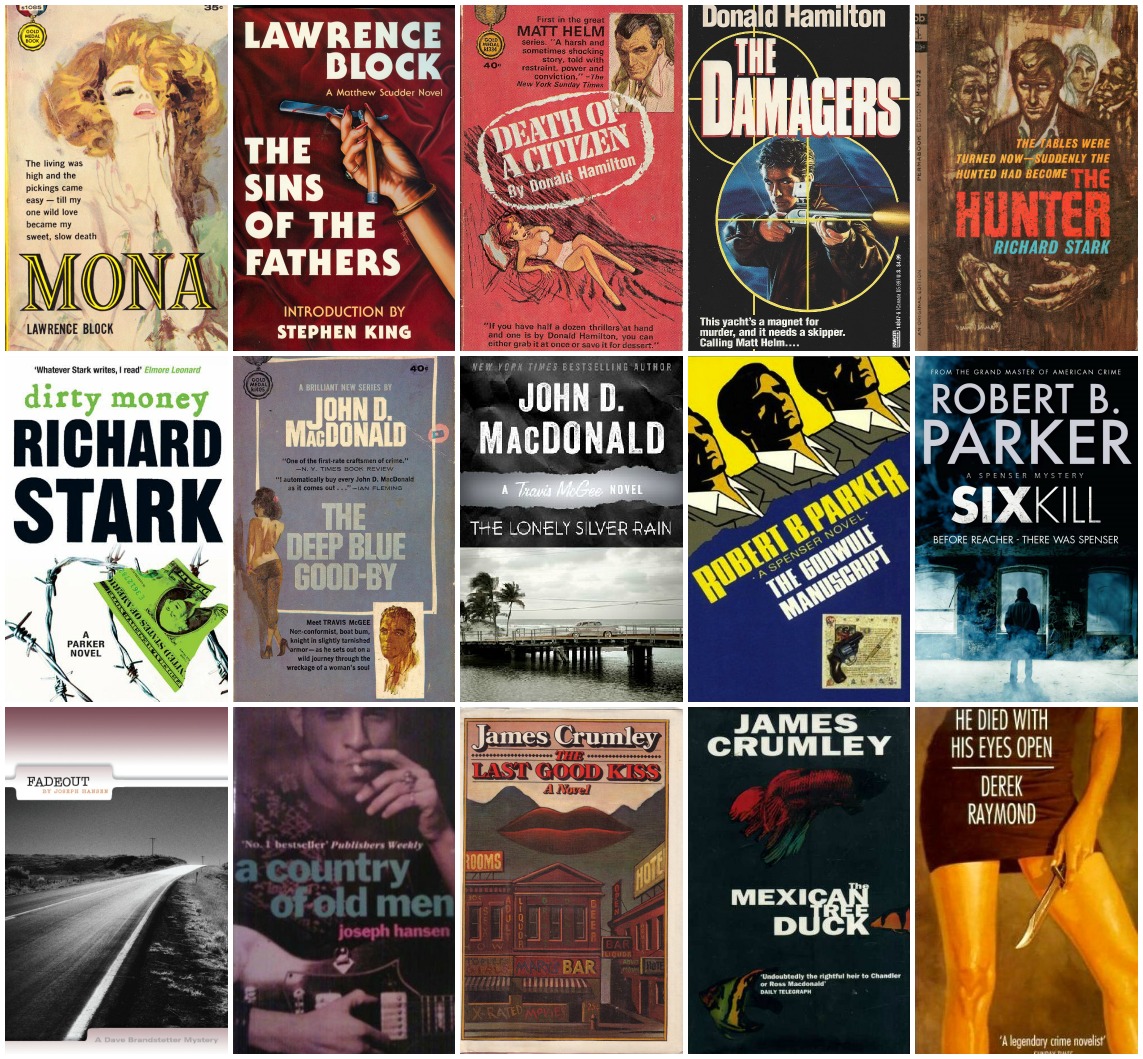
One of the most important names in the history of the genre is Lawrence Block, he got started writing short stories during the heady days of the paperback originals (some of which are collected in the highly enjoyable Lost Weekends and One Night Stands) and had his first novels published in the early 60s. Amongst his mixed bag of early work the superb and disturbing Mona AKA Grifter’s Game (1961) has the distinction of being the first novel republished by the excellent Hard Case Crime imprint. He is a man that appears to have adapted quite readily to the need for recurring protagonists with no fewer than six different series created by him since the mid 60s. The Sins of the Fathers (1976) marks the debut of perhaps his most popular character, Matt Scudder.

Swedish born American Donald Hamilton is someone that isn’t so readily known in the 21st century but his character Matt Helm was created for Gold Medal Books in Death of a Citizen (1960) and ran for 27 books until The Damagers (1993.) Helm is a no-nonsense kind of guy, working as an undercover counter-terrorist agent he narrates his escapades with a detached, dead pan style include the many fights, torture sequences and sexual conquests.
"Donald Hamilton has brought to the spy novel the authentic hard realism of Dashiell Hammett; and his stories are as compelling, and probably as close to the sordid truth of espionage, as any now being told."
Donald Westlake was an incredibly prolific author in the genre who used many pseudonyms to divide up his different work. His most famous being Richard Stark, creator of the hard-boiled Parker, a ruthless master thief willing to do whatever it takes to get what he wants. Parker first appeared in The Hunter (1962) and went on to star in a further 23 novels until Dirty Money (2008).

The Deep Blue Good-Bye (1964) marked the debut of hard-boiled detective Travis McGee. His creator John D. MacDonald would write one book per year until The Lonely Silver Rain (1985) brought the sequence to a close after 21 adventures. McGee is known for being a misogynist, a character that has dated quite badly and can easily offend some readers. MacDonald has an easygoing approach to the series, his detective lives on a houseboat and would prefer to lounge around drinking to solving crimes, that belies the intricate plotting he uses and misogyny aside this is a great series of third generation hard-boiled fiction.

Robert B. Parker wrote his Ph.D dissertation on Hammett, Chandler and Ross MacDonald and went on to create his own legendary private eye, Spenser in The Godwulf Manuscript (1973). Parker is known for his modern approach to the classics of the genre and including series characters from minority backgrounds as more than just punchbags for his protagonist. Sixkill (2011) was the 40th Spenser outing and was the last novel he finished before his death, making Spenser The Rolling Stones of hard-boiled fiction.

Joseph Hansen is best known for his ground breaking series of crime novels starring his most iconic creation, Dave Brandstetter, an openly gay insurance investigator who still embodied the tough, no-nonsense personality of the classic hardboiled private investigator type of protagonist. His first outing was Fadeout (1970) and he went on to appear in eleven more novels until A Country of Old Men (1991).

James Crumley is a self-declared heir to the Chandler tradition, he defines his own sensibility as conditioned by the disillusionments of the Vietnam War and his vision of justice less clear-cut. His protagonists are environmentalists and sustained by eccentric alliances with criminals and other misfits. Described as the literary offspring of Chandler and Hunter S. Thompson he was another author who found success outside of America long before the Americans took to him. His book The Last Good Kiss (1978) features the alcoholic ex-army officer turned private detective, C.W. Sughrue, as it’s protagonist and has been labelled as the most important crime novel of the last 50 years, influencing much of what will be described as the fourth generation of hard-boiled and noir writing. The Mexican Tree Duck (1993) is the only one of his novels to be acknowledged with an award.

I’ll now break my own rules and mention briefly the British author Derek Raymond. In 1984 he wrote the first book in The Factory Series, He Died With His Eyes Open, a book that seems to have captured both the hard-boiled spirit of Chandler and the blackest, bleakest noir poetics of David Goodis in one wonderful novel. Whilst he wasn’t American he is the closest I have found to true hard-boiled and noir fiction outside of America and deserves to be read by all fans of the genre.

Part four will bring us right up to date with a quick look at some of the shining lights in contemporary American hard-boiled and noir fiction.


You can find me discussing books on Goodreads, discussing movies on Letterboxd, tweeting nonsense as blahblahblahtoby  feel free to say hi.
Tuesday, January 8, 2013

The Case of the Paperback Original: A Brief Overview of Hard-Boiled and Noir Fiction Part Two

The articles in this series were originally written for and posted at Literary Exploration.

There are literally dozens of great authors and great novels that could have been suggested as essential reading for this guide. The writer of the article went through agonising decisions over who to leave out and is more than aware that your favourite author probably hasn’t been mentioned but feel free to start a discussion in the comments.

A (not-so-brief) Brief Overview of Hard-boiled and Noir Fiction

Part Two – The Case of the Paperback Original (1950s)

In part one we looked at the birth of the genre as a more realistic type of literature in reaction to the traditional whodunit from Britain. The cynical approach towards life of the protagonist summing up the attitude of the hard-boiled hero and how the worlds of noir novels are never happy places where things go right.

We looked at Hammett and Chandler and Cain, the three pillars of the style that all who followed evolved from. Now we move on to the second generation of hard-boiled men who took advantage of a new publishing idea and the post WWII atmosphere of paranoia and fear.

Fawcett publications created the Gold Medal Books imprint in 1949 with the idea of publishing pulp novels directly to paperback formats. Paperback originals were published for the first time under this new imprint and very quickly became the home of noir fiction, the dark brand of crime writing that would go on to capture the mood of the general public.

At the end of WWII a new fear was brewing in the minds of America; images of nuclear warfare were embedded on the consciousness of a generation of people and McCarthyism via the House Committee on Un-American Activities hearings instilled a previously unknown universal paranoia to the people.

These two key developments combined to provide a hotbed for bleak, raw, sleazy, deranged, violent, uncompromising, chilling, and warped, existentially horrific noir fiction with novels selling in excess of one million copies on a regular basis and spawning numerous copycat publishing imprints.

The first name from this second generation is one a lot of people are already familiar with, Mickey Spillane; his first Mike Hammer novel was I, The Jury (1947) and continued to write in to the 50s yet it wasn't until the end of the era that he really came in to his own. Kiss Me Deadly (1952) was the basis for the iconic film noir of the same name and serves as a great introduction to a protagonist who is a complete and unashamed misogynist, unafraid of offending anyone, in stories that you jump on and ride like the wind through intrigue, fist fights, witty dialogue, sexual encounters and the inevitable denouement.

The other name that regularly gets mentioned as the obvious hardboiled heir to Chandler and Hammett is Ross MacDonald. The Moving Target (1949) was the first appearance of Lew Archer, a PI that would last through 18 novels to The Blue Hammer (1976). This series longevity alone makes MacDonald stand out from the field of hard-boiled authors but the growth of the character and the evolution of writing style from Chandler copycat to a writer who was as comfortable with poetic imagery and psychological insight as witty putdowns and biting sarcasm marks him as one of the true greats of the genre.

Gil Brewer is something of a forgotten man but he was prolific and popular in his time, having over 30 novels published in the new paperback original format. But to those in the know Gil Brewer is a treasure trove of 50s noir goodness. His protagonists are ex-soldiers, ex-cops, drifters, convicts, blue-collar workers, charterboat captains, unorthodox private detectives, even a sculptor.  The plots range from searches for stolen gold and sunken treasure to savage indictments of the effects of lust, greed, and murder to chilling psychological studies of disturbed personalities. The Vengeful Virgin (1958) that was recently republished by Hard Case Crime and The Red Scarf (1955) are amongst the standout titles from his bibliography.

Another man you could make the same statements about is Day Keene, the pair seems to go hand in hand infact. Even more prolific than Brewer, Keene has left a lasting legacy of entertaining noir stories that occasionally border on genius. Hard Case have also reissued a Keene novel in Home Is The Sailor (1952), you may also enjoy To Kiss or Kill (1951) and Dead Dolls Don’t Talk (1959).

Charles Willeford is the author who found fame in the 80s with his Hoke Mosely series but he published High Priest of California (1953) at the start of the boom in paperback sales and quickly followed it up with Pick-Up (1955) whilst still enlisted in the air force. Charles Willeford, in his best works, puts art, aesthetic sensibility, critical acumen, morality, and American ideology on a dramatic collision course, he was known for his quirky nature and eccentric characters and his juxtaposition of humour and violence is said to have influenced a young Quentin Tarantino (but then what didn’t?)

The other big Charles of the period was Charles Williams and he really was a BIG Charles. In 1951 his debut novel sold over one million copies in a time when one hundred thousand was the norm and in 1953 he became the first paperback original to be reviewed by The New York Times. Widely praised by critics Charles Williams is to the paperback originals what Hammett was to the 30s. He is known for frequently satirizing his male protagonists' points of view, while implicitly reassessing the traditional genre figure of the femme fatale.

As mentioned previously about Woolrich, Williams was always more popular in France and only A Touch of Death (1954) and River Girl AKA The Catfish Tangle (1953) appear to be in print in English, a fact made even more shocking by the following statement made by pulp historian Woody Haut:
"So prolific and accomplished a writer was Charles Williams that he single-handedly made many subsequent pulp culture novels seem like little more than parodies."
David Goodis is perhaps my personal favourite from this period (again he is widely available in French but not so much in English) his novels depicting the bleakness and darkness of lives in free fall, his words a statement of frustration, telling tales of gloom, depression and despair. Noir at its blackest. Down There AKA Shoot The Piano Player (1956) and Cassidy’s Girl (1951) represent him at his peak.

I’ve saved the biggest name, arguably the best writer of the bunch and possibly the most prolific for last, Jim Thompson. There are no good guys in Thompson's literature; everyone is abusive, opportunistic, or simply biding time until able to be so. His style and prose elevated his work above well written genre pieces and in to literature which resulted in him being dismissed as just another pulp writer by those that read the paperback originals. The Killer Inside Me (1954), is perhaps his most famous work and represents the first time the reader was treated to an intimate portrait of a psychotic mind whilst The Grifters (1963) was his most successful movie adaptation.

Part three will take a look at the end of the popularity of paperback originals and what happened to crime fiction in the 60s and 70s.

You can find me discussing books on Goodreads, discussing movies on Letterboxd, tweeting nonsense as blahblahblahtoby, feel free to say hi.

Monday, January 7, 2013

A Not So Cosy Mystery: A Brief Overview of Hard-Boiled and Noir Fiction Part One

The articles in this series were originally written for and posted at Literary Exploration.

There are literally dozens of great authors and great novels that could have been suggested as essential reading for this guide. The writer of the article went through agonising decisions over who to leave out and is more than aware that your favourite author probably hasn’t been mentioned but feel free to start a discussion in the comments. 

A (not-so) Brief Overview of Hard-boiled and Noir Fiction

Part One - A Not So Cosy Mystery (1930s and 1940s)

In 1887 Arthur Conan Doyle created Sherlock Holmes and the success of his great detective spawned an entire genre of detective fiction that imitates to some degree or another to this date. The light-hearted and relatively straightforward approach towards solving crime reached its pinnacle in what has become known as The Golden Age of crime fiction, the 1920s and 1930s. The large majority of the authors writing in this popular style of fiction were British and this was reflected in the settings and general sense of manners contained within.

The inter-war years were a difficult time both socially and politically and this change in society saw crime fiction edge towards what was a more realistic, and more depressing tone with content that would almost certainly shock the characters found within an Agatha Christie novel. The pioneers for this movement towards realism were, perhaps unsurprisingly, Americans and this style became known as hard-boiled.

Taking its name from the style of preparing eggs that leaves the hard shell intact and the yolk fully solidified, the protagonists of hard-boiled fiction are tough skinned, street wise, sharp tongued and ready to solve a mystery with violence if necessary (and it almost always is.)

These are cops, private detectives, ordinary citizens coming up against prohibition gangsters, organised crime, crooked cops, and looking to stand up for what is morally correct. One lone man against an entire system; grown cynical and expecting the worst of people but hoping for the best, he’s the kind of guy who’s seen every horror and will surely see worse before he solves this case.
Hard-boiled is a naturalistic style of writing combined with a cynical, world-weary attitude. This evolved in to Noir fiction, a genre that is if anything even darker; it’s protagonists are usually morally suspect at best and at worst are degenerates, psychopaths and cold blooded murderers.

The most succinct and accurate definition of the difference between the two styles is this:
Noir is the world. Hard-boiled is the character. You can have Noir without the Hard-boiled, but not the other way around.
Carroll John Daly is credited with creating the first hard-boiled story for Black Mask magazine in the 1920s and his first hard-boiled novel Snarl of the Beast (1927) marks the first of, what I shall deem, the essentials of the genre. At the time Daly was the most popular author of the genre he essentially started but he has since been unfairly labelled a hack (the writers opinion only) for simply not being of the same quality as the famous authors he inspired.

Hot on the heels of Daly was Dashiell Hammett, the former Pinkerton operative turned author, who between 1929 and 1934 published the only novels he ever wrote. At least two of which are widely considered masterpieces of the genre. Red Harvest (1929) featuring the unnamed detective known as The Continental Op and perhaps his most famous work The Maltese Falcon (1930); it’s PI Sam Spade is credited as being the archetype that all other hard-boiled detectives are based on, with his personal detachment from the case and unflinching devotion to ensuring justice his strongest characteristics.

The man who would follow in his footsteps, Raymond Chandler, said of him:
“Hammett gave murder back to the kind of people that commit it for reasons, not just to provide a corpse...He put these people down on paper as they are, and he made them talk and think in the language they customarily used for these purposes.”

A more obscure name with an essential of the genre crops up next, Raoul Whitfield; his debut novel Green Ice (1930) was described by Dashiell Hammett as “280 pages of naked action pounded into tough compactness by staccato, hammerlike writing” but he never seemed to live up to his early success and retired from writing fiction only a few years later.

There are three names that everybody mentions when discussing this period of early hard-boiled American fiction. Hammett is the first, his Maltese Falcon regularly winning polls for best hard-boiled novel also, but to his name you will also find added the words Chandler and Cain.

Raymond Chandler decided to try his hand at writing after losing his job during the Depression and in the process seemed to capture America the way that America wants to be remembered. His hero is Philip Marlowe, his beat is L.A., a brave warrior in the Sam Spade mould but with a softer underbelly. In his classic debut The Big Sleep (1939) we find a PI who likes to drink, is handy in a fight and cynically wisecracks his way through most situations but this is also a man who plays chess, reads poetry and has philosophical questions playing on his mind. The generally acknowledge highpoint in Chandler’s (and Marlowe’s) career would come later with The Long Goodbye (1953) and demonstrates the literary nature of the genre, author and character.

James M. Cain on the other hand was largely active in the noir category; in his major works his characters were not detectives but men corrupted by sex and money. Double Indemnity (1943) is the story of an insurance agent who plots against his employers to get a woman and some money. The Postman Always Rings Twice (1934) features a mixture of sexuality and violence in a love triangle situation.

With the big names out of the way I will share two more important figures in the formative years of this genre that are a lot harder to find and therefore more obscure.

Cornell Woolrich, who also wrote with some success under the pseudonym William Irish, is virtually out of print today but his importance on the development of the genre remains. His work more often that not evoked despair and cynicism in the everyday life scenarios and as was the case with the bleaker examples of the genre was more popular in France than America. If you can find them, I recommend The Bride Wore Black (1940) and The Black Angel (1943) as good starting points.

Dorothy B. Hughes is another essential early noir author that few people have heard of. Her In A Lonely Place (1947) has recently been republished as a Penguin Modern Classic and quite rightly so, is a fine example of her tightly plotted and tense approach towards noir and features a truly heinous protagonist in Dix Steele. Amongst her other work The Blackbirder (1943) is a story of fear, paranoia and dread.

In Part Two I’ll be taking a look at the second generation of authors who worked during the boom in paperback fiction of the 1950s.

You can find me discussing books on Goodreads, discussing movies on Letterboxd, tweeting nonsense as blahblahblahtoby  feel free to say hi.